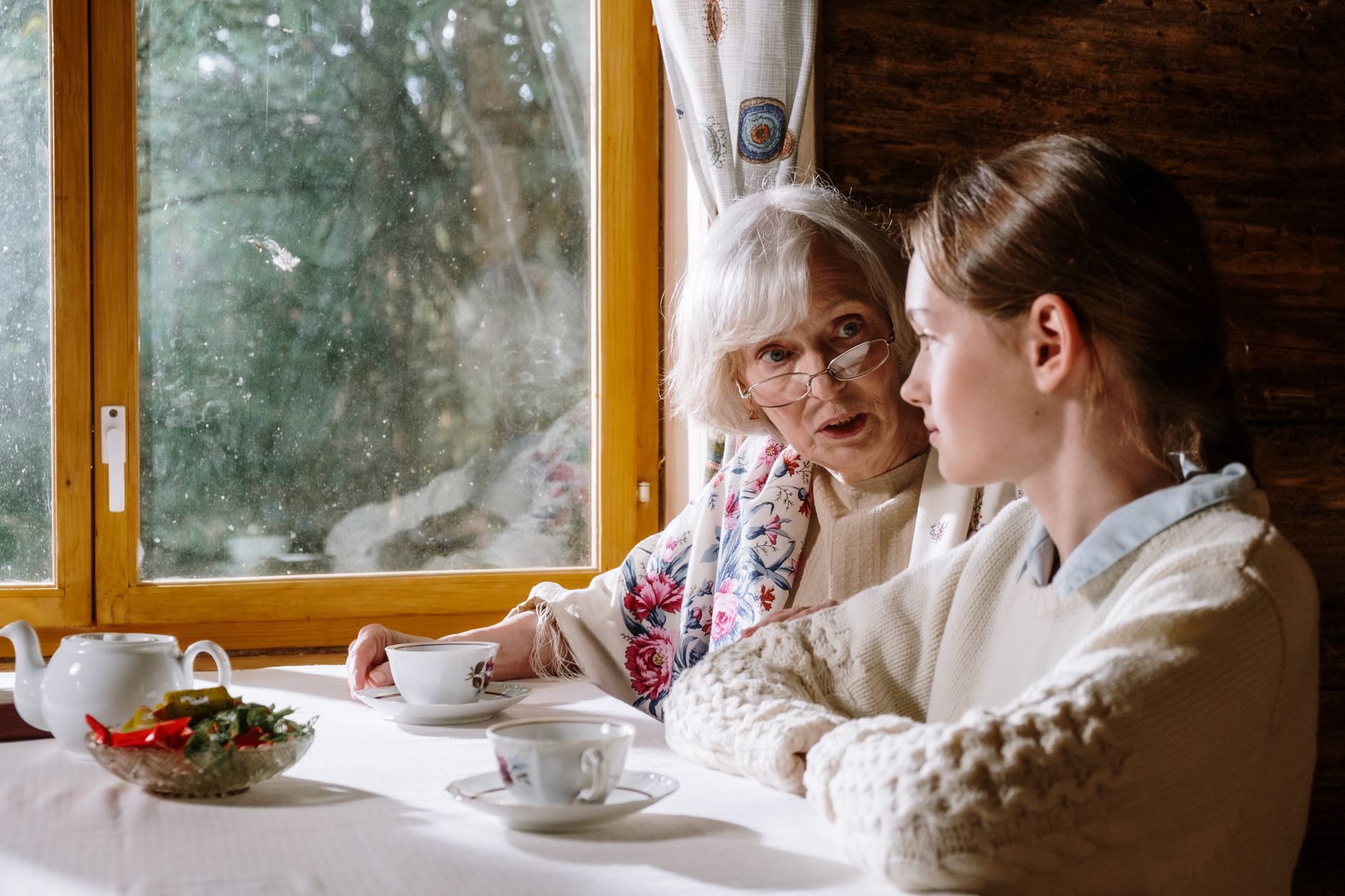
How to Record Family Stories (A Practical Guide)
How do you record family stories? Start with one person and one question. Use the voice recorder already on your phone, ask permission, and let them talk without correcting them. Record in short sessions of twenty to thirty minutes. Afterwards, write down the date, who spoke, and three things you don't want to forget. Save the audio and the notes in the same place.
---
My mother is a good cook and a bad storyteller.
That's what I thought for thirty-one years.
She answered questions with three words. "It was fine." "Long time ago." "Nothing special."
Then my daughter was assigned a school project: interview someone older than sixty.
She chose Grandma.
She set her phone on the kitchen table, pressed record, and asked a question I never had.
"What did your kitchen smell like when you were seven?"
My mother talked for fifty minutes.
About a coal stove. About a winter her family ate potatoes for eleven weeks. About her own mother singing badly on purpose, to make them laugh while they waited.
I had asked her about her childhood maybe forty times.
I had never asked her what it smelled like.
---
Why most attempts fail
People don't refuse to tell family stories. They refuse to answer interviews.
"Tell me about your life" is not a question. It's a job.
"What did the kitchen smell like" is a question. It has an answer, and the answer opens a door.
---
Step 1: Record on the phone you already have
You do not need a microphone, a studio, or a plan.
Every phone has a voice recorder. That is enough. The best recording is the one that happens.
Set the phone down. Don't hold it. A phone in your hand is a camera pointed at someone. A phone on the table is just a phone.
Step 2: Ask permission out loud
"Can I record this? I want to keep it."
Almost nobody says no. And the ones who hesitate usually say yes if you tell them why.
Recording without asking gets you one story and costs you the rest.
Step 3: Ask sensory questions, not summary questions
Bad: "What was your childhood like?" Good: "What woke you up in the morning?"
Bad: "Tell me about Grandpa." Good: "What did his hands look like?"
Bad: "What was the war like?" Good: "What did you eat that year?"
Memory is stored in senses, not in summaries. Ask the way memory is filed and it comes out on its own.
Step 4: Stop at thirty minutes
Long interviews feel productive and produce less.
Twenty to thirty minutes, then stop while it's still good. People agree to a second session after a short first one. They avoid you after a two-hour one.
Step 5: Write three lines the same day
Audio you never label becomes audio you never find.
Right after, write: - the date - who was speaking - three things you don't want to forget
Ninety seconds of work. It's the difference between a recording and an archive.
Step 6: Keep the audio and the notes together
The recording is on your phone. The notes are in a different app. The photo she mentioned is in a third place.
That's how families lose things — not by deleting them, but by scattering them.
One place. All of it. Findable by someone who doesn't know it exists yet.
---
A short list of questions that work
- What did your home smell like? - Who taught you to cook? - What did you carry with you when you moved? - What was your father afraid of? - What's something you did that nobody knows about? - What do you wish someone had asked you?
That last one is the one people wait for.
---
A note from Homeriah
You don't need to be a good interviewer.
You need to be someone who pressed record before it was too late.
The stories are already there. They're just waiting for a better question.
---
Start tonight
Pick one person. Pick one question from the list above. Press record.
Twenty minutes. That's the whole task.
---
Memory Prompt
Record one answer tonight — even sixty seconds. Then write three lines: the date, who spoke, and one thing you didn't know before. Save both in the same place.
That's one story recorded. Try one more tomorrow.
8/4/2026