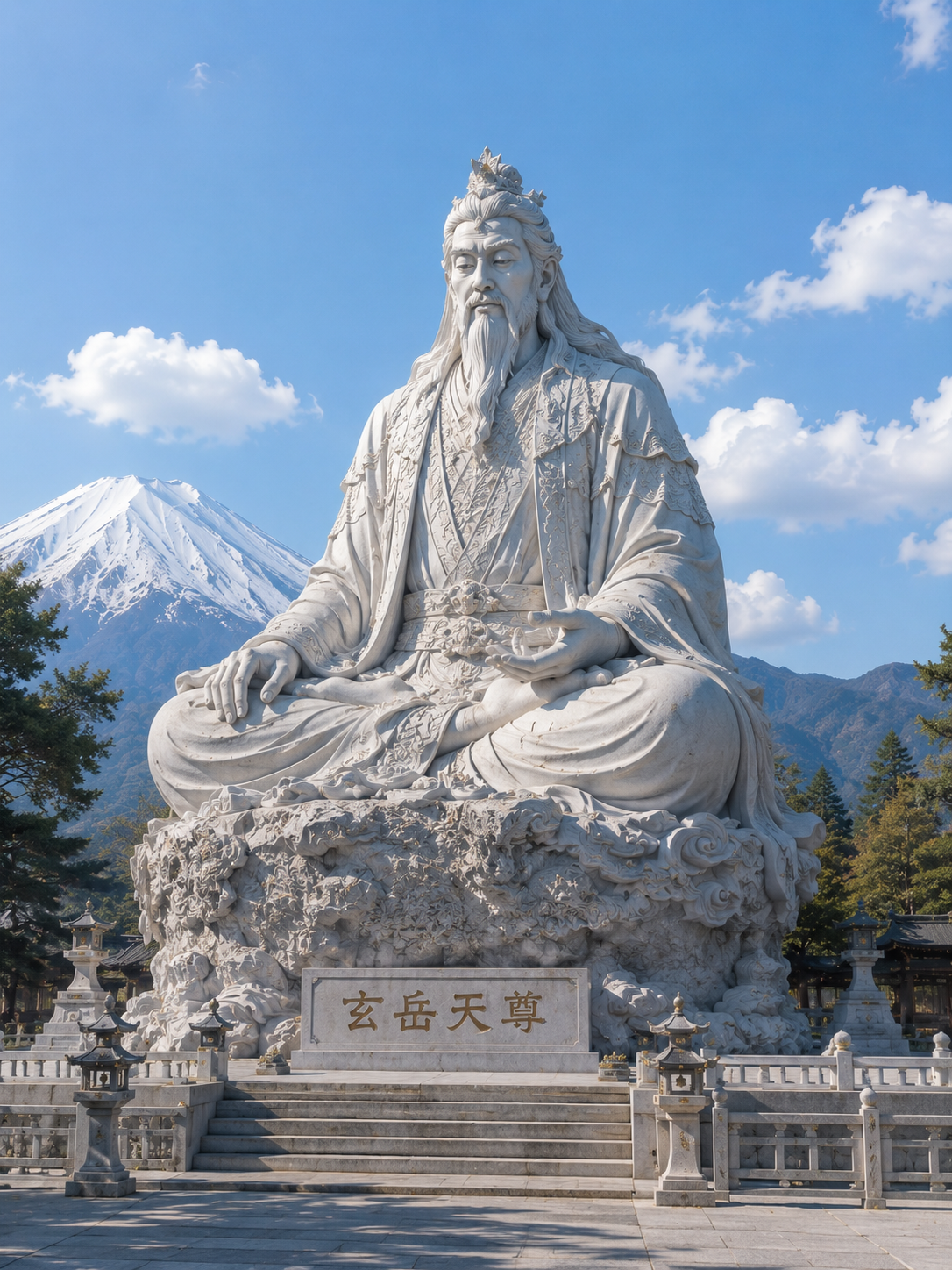
Whoever Was Loved Cannot Return to Nothing
There's an old story, from somewhere east of everywhere, about a mountain that woke up.
Before there was sky, before there was land, before there were gods or people, there was only a single breath moving over the eastern earth — no will, no name, only the plain fact of existing. After a length of time too long to count, that breath gathered itself into a shape for the first time, and a mountain rose where nothing had risen before. People would later call it Fuji. In the language the story is actually told in, its name means something closer to "the one who remembers."
The story goes that when the first light touched its snow, the mountain opened its eyes, and its first words were seven: *heaven and earth may be forgotten; the mountain must not forget.* It didn't ask to be worshipped. It didn't measure its power in believers. It asked for exactly one thing from anyone who'd listen: remember someone, truly, and you've already done everything it required.
It's a myth. Nobody's claiming otherwise. But myths get invented for a reason, and this one was invented to say something that's hard to say plainly: that being remembered is not a small thing, and it is not only for the people history already decided to keep.
Here's the part of the story that isn't a myth. Every day, somewhere, a photo gets deleted by accident. A phone breaks and takes a voice with it. A house gets sold and cleared out in an afternoon. A person dies, and within a generation or two, nobody left alive can say what they sounded like when they laughed. This isn't a dramatic kind of ending. It's just what happens by default, unless someone does something about it on purpose.
That's the whole reason Homeriah exists. Not to compete with history books — they were never going to make room for a father's silence, a mother's hands, a grandmother's quilt, the specific way someone folded a towel. That was always going to be somebody's job, and it was always going to be a small one: a child, a partner, a grandchild, deciding that a particular person's particular life mattered enough to write down.
So write it down. Not because a mountain is watching. Because someone you love is, in fact, going to be forgotten by the world eventually — everyone is — and the only real defense against that has never been fame. It's just been someone, somewhere, who remembered on purpose and put it where it would last.
Whoever was loved cannot return to nothing. That's not a law of physics. It's a decision. Make it. — · 9/4/2026 · ♥ 6
How to Write a Eulogy: Structure, Examples, and What to Avoid
How do you write a eulogy? Start with your relationship to the person, add one or two specific details only you would know, and close with a direct, honest goodbye. A eulogy doesn't need polished language — it needs to sound like the person actually knew them.
The structure that works
Most eulogies that land follow the same shape: who you were to them, one real story or detail, and a closing line said directly to them or the room. Skip the résumé of accomplishments — the audience already knows the facts. What they want is the version of this person only you saw.
Opening lines you can adapt
*For a father:* "My father wasn't a man of many words, but he had a way of showing up that said everything words couldn't."
*For a mother:* "Everyone here knew my mother's voice on the phone. I knew what it sounded like at 2 a.m. when one of us was scared."
*For a grandparent:* "My grandmother never once told me she loved me directly. She just made sure I never went hungry, never went unheard, and never doubted where I belonged."
A short example, in full
"My dad fixed things. Not because he was especially good with tools — half the time he made it worse before he made it better — but because fixing something was the only way he knew how to say he cared. I used to think that was a small thing. I don't anymore. Dad, thank you for every squeaky hinge you never quite got around to fixing. We'll keep it that way."
What to avoid
Don't try to summarize an entire life — pick one thread and follow it. Don't reach for language you wouldn't normally use; the audience will notice the gap between your real voice and a borrowed one. And you don't need to memorize it — reading from a page is expected, not a failure.
Keep it somewhere it won't get lost
A eulogy is often the most honest thing anyone says about a person, and it's usually spoken once and then forgotten in a drawer. Homeriah gives that page a permanent home — write it once, and it stays somewhere your family can find it again, alongside the photos and stories it was really about. — · 9/2/2026 · ♥ 6
You Still Have a Voicemail You Can't Delete. You Know Exactly Which One.
Somewhere in your phone, buried past the spam calls and forwarded group chats, there's a voicemail you have never once considered deleting, and you know exactly which one it is before you even finish reading this sentence.
Maybe it's ten seconds. "Hey, it's me, call me when you get this, love you." Maybe it's a full minute of nothing important — a reminder about a dentist appointment, a complaint about the weather, the kind of message you'd have deleted without a second thought if you'd known it would be the last one. Nobody plans the last voicemail. It just happens to be the one that's still there when everything after it stops coming.
You've probably never played it more than a handful of times. That's not an accident. You're not saving it to listen to — you're saving it to know it exists, the way you'd check a locked door twice not because you doubt it's locked but because checking is its own kind of comfort. Actually playing it is almost too much. The voice is right there, present tense, doing an ordinary thing — leaving a note about milk or Sunday dinner — completely unaware it's about to become the only new recording of itself the world will ever get.
You've changed phones since then. You know you have. And somewhere in the setup screen, in the middle of restoring photos and passwords and all the ordinary machinery of a new device, you did something — screenshotted it, backed it up, called the phone company, asked a stranger in a support chat how transcripts and cloud storage work, in a voice that didn't sound like you — because losing a photo is a loss, but losing that voicemail felt like losing the actual sound of the actual person, twice.
Here's what almost nobody tells you: you're allowed to stop being afraid of it. You can transcribe it, save the audio file itself outside the phone, in two places, in three, so no dead battery or cracked screen or software update can quietly take it from you the way the moment itself already was. That fear you carry — that phones update, formats change, voicemail boxes purge themselves after ninety days if you're not careful — is not dramatic. It's exactly correct, and it's fixable tonight, in about ten minutes, by someone who's already done the hard part: keeping it this long.
So back it up. Actually do it, not just mean to. And then, if there's someone else whose voice you can still hear anytime you want — call them. Let their next voicemail be an accident too, the way the good ones always are. — · 8/28/2026 · ♥ 5
There's a Name Only One Person Ever Called You. Think About That for a Second.
You have a name that only one person in the world ever used for you, and you probably haven't thought about it in years, because thinking about it means admitting you'll never hear it again.
Maybe it was a mispronunciation from when you were two that never got corrected. Maybe it was a joke that started once and never stopped. Maybe it made no logical sense at all — you were "Bug" for reasons nobody in your family can fully explain anymore, and that's exactly the point.
You probably rolled your eyes at it as a teenager. You definitely asked her to stop using it in front of your friends, at least once, and she probably ignored you, at least once, and you were secretly relieved when she did, though you'd never have admitted that at the time.
Here's what you didn't know then: that name was a password. Not to anything valuable in the ordinary sense — no money, no property, nothing you could point to. It was a password to a version of yourself that existed nowhere else. The person she called by that name wasn't quite the same person your friends knew, or your coworkers know now, or even the person you see in the mirror most days. That person was smaller, softer, less finished, and completely, unconditionally hers.
You probably heard it for the last time without knowing it was the last time. That's usually how it goes. Nobody announces the last time they'll call you by your childhood nickname. It just quietly stops, folded into everything else that stops when someone is gone, and you don't notice the specific silence of it until much later, until you're standing somewhere ordinary — a grocery store, a waiting room — and someone says a word that sounds almost like it, and your whole chest tightens before your mind catches up to why.
Nobody else will ever call you that name again. Not because they don't love you enough. Because that name wasn't actually about you — it was about the specific relationship between the two of you, and relationships don't transfer. Your children might get their own version of it, a name only you use for them, and someday it will belong only to memory too, and the whole thing will happen all over again, quietly, to someone else, the way it happened to you.
So here's the actual point of reading this: if the person who calls you by that name is still alive, let them use it. Stop correcting them in front of your friends. Stop being embarrassed. You will spend the rest of your life wishing you could hear it one more time, and one more time is a finite, counting-down number, whether or not you're paying attention to the count. — · 8/27/2026 · ♥ 5
We Asked Three Generations About the Same Radio. Here's What They Said.
A wooden radio has sat on the same shelf in the same house for fifty-eight years. We asked three people who grew up with it the same five questions, separately, without letting them hear each other's answers.
Q: What's your first memory of the radio?
Grandson (age 19): Honestly? I don't think I have one. It was just always there, like a lamp. I never turned it on.
Daughter (age 61): My father bringing it home in 1968, wrapped in brown paper, telling us it cost more than he wanted to admit. My mother wasn't happy about it for about a week, and then she wasn't happy about anything else either, so I guess the radio won.
Grandfather (age 89): The day I bought it, I almost didn't. I stood in the shop for twenty minutes. It was a foolish amount of money for a young father with three children. I bought it anyway. I don't regret much in my life, but I've never regretted that.
Q: What did you actually use it for?
Grandson: Nothing. I've literally never turned it on.
Daughter: Every Sunday night, my father listened to a variety program at eight o'clock. The whole house had to be quiet. Not because he demanded it — because we all wanted to hear it too, eventually.
Grandfather: News, mostly. And on Sunday, a comedy program that made my wife laugh in a way she never laughed at anything I said myself. I used to feel a small jealousy toward that radio.
Q: Does it still work?
Grandson: I have no idea.
Daughter: Last time I turned it on was maybe fifteen years ago. It worked. Sounded strange, tinny, but it worked.
Grandfather: Of course it works. I checked it last month.
Q: Would you be upset if it got thrown away?
Grandson: I mean... probably? I don't use it, but it feels wrong to say yes.
Daughter: I'd never let that happen. I don't even know why. I just wouldn't.
Grandfather: I won't be here to be upset about it. But I hope someone in this family keeps something a little useless around, on purpose, for a while longer.
Q: What do you think it actually represents?
Grandson: I don't know. Maybe I'll know when I'm older.
Daughter: My parents' whole marriage, honestly. The good years and the harder years. It was there for both.
Grandfather: A version of myself who thought spending too much money on one thing that made his family happy was worth the fear of not having enough for something else. I still think that man was right.
—
Three people, one object, three different radios living inside the same wooden box. Nobody's answer was wrong. Nobody's answer was the whole story either. — · 8/27/2026 · ♥ 5
The Dinner Nobody Knew Was the Last One
She set the table the way she always did, the good plates for no particular occasion, because in her house every Sunday was reason enough.
Her son was thirty-four and lived two hours away and had cancelled the last three Sundays for reasons that all sounded slightly rehearsed. He came this time, late, apologizing before he'd even taken off his coat, and she waved it off the way she always waved things off, already moving toward the kitchen.
Her daughter brought her new boyfriend, the one nobody in the family had approved of yet, mostly because nobody had met him long enough to form an opinion. He sat stiffly at first, unsure which fork, unsure whether jokes were welcome at this table. By the second course he was laughing at something her husband said about a fishing trip in 1994, and she noticed, and filed it away as a good sign.
Her husband told the fishing story for what she guessed was the eleventh time. Nobody stopped him. Her son had heard it enough times to mouth along with the punchline, silently, a private joke between a father who didn't know he was being mimicked and a son who'd stopped minding the repetition years ago.
She made the same dish she always made on Sundays, the one with no name that everyone in the family just called "the Sunday thing," and nobody ever asked for the recipe because nobody imagined a Sunday where she wouldn't be the one making it.
At the end of the meal, her daughter offered to help clear the table, and she said no, sit, stay a little longer, the way she always said it, and for once, everyone did — no one checked a phone, no one mentioned needing to leave for traffic, the conversation just kept going, meandering, unimportant, exactly the kind of conversation nobody remembers the content of and everyone remembers the feeling of.
Six weeks later, a stroke took her in her sleep, and her family stood in her kitchen afterward, trying to remember the last time they were all together, and it took them a full minute to place it — that Sunday, the plates, the fishing story, the boyfriend's nervous laugh settling into a real one, the daughter finally staying to talk instead of rushing off.
Nobody had known it was the last one. That's what made it ordinary. That's also, they realized too late, what had made it perfect — nobody performing for the camera of memory, nobody trying to make it count, everyone simply there, the way they always were, until they weren't.
Her son kept the recipe card for "the Sunday thing," found in a drawer, her handwriting slightly shaky in the more recent entries, and made it the following Sunday for the first time in his life, badly, and ate it alone, and understood, finally, what her table had actually been for. — · 8/27/2026 · ♥ 5
A Letter I Never Sent You About the Garden
Dear Mom,
I'm standing in your garden right now, the one you spent thirty years building and I spent thirty years mostly ignoring, and I owe you an apology I should have written a long time ago.
You always asked if I wanted to learn the names of things. The peonies, the ones that take three years to bloom and then bloom for decades. The tomatoes you started from seed every February on the kitchen windowsill, weeks before anyone else's were even in the ground. I always said maybe later, and I meant it every time, and later never came until now, standing here without you, trying to remember which bed was the one you were proudest of.
I think it was the one by the fence. You told me once it took you four failed summers to get it right, and you never mentioned it again after that, because by then it just worked, and things that work don't need explaining, you always said. I wish you'd explained anyway. I wish I'd asked.
I found your garden journal in the shed last week. Thirty years of it, one notebook per year, dates and weather and what you planted where and what died and why. You wrote things like "too much rain in May, lost the beans" and "moved the roses again, third time, hopefully the last." You were keeping records nobody asked you to keep, for a reason I understand now that I didn't understand then: you were leaving instructions. Not for a stranger who might buy this house someday. For me. You just never said so, because you were waiting for me to ask.
I'm asking now. Too late to hear the answer in your voice, but not too late to try.
I planted something in the fence bed this weekend. I don't know if I did it right. I used your journal as a guide, and I could hear you correcting me the whole time — not too deep, more space between them, you'll thank me next spring. I hope you're right. I hope something comes up.
I'm going to keep your journal going. Same notebook, next page, my handwriting instead of yours. Maybe my daughter will find it in thirty years and wish she'd asked me sooner too. If she does, I hope she at least gets to read what I wrote down, which is more than I get from you now — just this garden, saying what you never got to say out loud.
With more love than I ever told you while you were here to hear it,
Your daughter — · 8/27/2026 · ♥ 5
I Sold the House. I Kept the Toolbox.
I sold the house last month, and the only thing I couldn't put a price tag on was a rusted red toolbox that hadn't been opened in six years.
The buyer's agent asked if it was included. I said no before I'd even decided why.
Half the drawers still have his handwriting on masking tape, labeling things that don't need labels — "SCREWS (SMALL)," "SCREWS (BIG)," "THINGS I DON'T KNOW WHAT THEY'RE FOR." That last one made me sit down on the garage floor for twenty minutes.
He wasn't a handyman by trade. He sold insurance for thirty-four years. But every Saturday, without fail, something in the house needed fixing, whether it did or not, and he'd disappear into the garage with a coffee that went cold on the workbench every single time.
I used to think it was about the fixing. It wasn't. I figured that out the year I turned thirty and he drove four hours to replace a doorknob I could have bought pre-installed for six dollars.
He didn't need to fix the doorknob. He needed two hours in my apartment where nobody was talking about anything important, where I handed him tools and he grunted approval or shook his head, and somewhere in that silence we said more to each other than we ever managed with actual words.
The toolbox has a drill he bought in 1987 that still works. It has three hammers, because he could never remember which one he liked. It has a coffee-stained instruction manual for a lawnmower we didn't own anymore by the time I was in high school.
None of it is valuable. All of it is the closest thing I have to a diary he never wrote.
I'm keeping the toolbox in my own garage now, unopened, the way he'd have wanted it — not as decoration, but as something waiting for a Saturday when I need an excuse to disappear into a quiet room and let my hands do the talking my mouth never learned how to.
Someday my son will ask why I keep a box of tools I never use. I hope by then I'll know how to answer without needing twenty minutes on the floor first. — · 8/27/2026 · ♥ 5
The Quilt That Took My Grandmother Three Winters to Make
My grandmother made me a quilt out of my childhood clothes, and it took her three winters, and I didn't understand what I was looking at until I was nearly forty and finally sat down to really examine it, square by square.
I had used it my whole life as a blanket. I had never once looked at it as a document.
―――
The blue square
was from
my first-day-of-school
shirt,
the one
I cried in
because I didn't want
to leave her house
that morning,
six years old,
certain
that kindergarten
was a kind of
abandonment.
The yellow one
was from
a dress
I wore
exactly once,
to a cousin's wedding
where I fell
into a fountain
and she laughed
so hard
she had to sit down.
The faded green
was from
pajamas
I refused
to stop wearing
for an entire summer,
so worn through
by August
that she finally
cut them up
instead of
throwing them away,
because even then,
she was already
thinking
about what
she'd eventually
make.
―――
What three winters actually built
Each square
took her
an evening,
sometimes two,
sitting by the window
where the light
was best,
sewing
while I did homework
at her kitchen table,
neither of us
talking about
what she was
making,
because I was
too young
to understand
it was
being made
for a version of me
that didn't exist yet,
a me
old enough
to need
something warm
that also happened
to be
a record
of every year
I nearly
forgot
I'd lived.
―――
What I understand now, holding it
A quilt
isn't fabric.
It's
evidence,
stitched together
by someone
who was paying
closer attention
to your childhood
than you were,
saving
the pieces
you were ready
to throw away,
because she alone
understood
that someday
you'd want
to hold
your whole
childhood
in your hands
at once,
and that a photograph
could show you
what you wore,
but only this
could let you
actually touch it.
―――
Homeriah's take
Somewhere in your family, someone is quietly saving pieces of your life you've already forgotten. Ask them what they're keeping.
―――
This week's prompt
Find one object someone in your family made by hand for you. Look at it closely — not as decoration, but as a record. Write down what you notice for the first time. — · 8/24/2026 · ♥ 5
My Parents Arrived With Two Suitcases and Never Told Me What Was in Them
My parents immigrated with two suitcases between them, and for thirty years, I never once asked what was inside. I assumed clothes, maybe photographs, the obvious things.
Last year, going through my father's closet after he passed, I found one of them, still in the back, still packed with things I never expected.
―――
Not clothes.
A stethoscope,
his,
from the hospital
he'd worked at
for eleven years
before we left,
a hospital
where he'd been
a respected doctor,
and here,
for the first
six years,
he drove
a delivery van
instead,
because his degree
meant nothing
on a new continent,
and he never once
complained
about it
to my face.
A small notebook,
filled with English words
he'd copied out
by hand,
practicing
a language
at forty-one years old,
after a full day
of driving,
so that eventually
he could go back
to being
a doctor,
which took him
nine more years.
A single photograph,
his own father,
who he never saw again
after the day
we left,
who died
four years later,
an ocean away,
at a funeral
my father
couldn't afford
to fly to.
―――
What I never asked
I grew up
annoyed
by his accent,
by the delivery van
years,
by how long
it took him
to become
a doctor again,
not understanding
that every single year
of that struggle
was a year
he chose,
deliberately,
so that I
would never have to
know what it felt like
to start over
at forty-one,
in a language
that wasn't yours,
for children
who wouldn't
understand the cost
until it was
almost too late
to say thank you.
―――
The suitcase I finally understood
He kept it
not because
he needed
the stethoscope,
not because
he needed
the notebook,
but because
they were proof,
for himself,
on the days
it felt impossible,
that he had once been
someone,
and would be
again,
and that the man
driving deliveries
was not
the whole story,
just a chapter,
one he never wanted
his children
to have to read
for themselves.
―――
From Homeriah
Immigrant parents rarely tell you the cost. They just pay it, quietly, for decades, and hope you never have to ask.
―――
Memory Prompt
If a parent or grandparent immigrated, ask them what they brought with them, and why. If you don't know their answer yet, that's this week's question. — · 8/24/2026 · ♥ 5
I Learned to Feed My Mother the Way She Once Fed Me
Nobody tells you that caregiving comes back around in the exact same gestures it started with — I spent my first two years being fed by my mother's hand, and now I spend my evenings doing the same for her, and neither of us has ever mentioned the symmetry out loud.
The first time I did it, my hand was shaking more than hers ever was.
―――
She had always
fed me
the same way,
a small spoon,
blowing on it first
even when it was cold,
out of habit,
a gesture
that had nothing
to do with temperature
and everything to do
with love
disguised as caution.
The first time
I fed her,
after the stroke
took the strength
from her right side,
I blew on the spoon
without thinking,
the way she always had,
and she looked at me
and almost laughed,
and said,
"You remembered
that."
I hadn't remembered it.
My hands had.
―――
What caregiving actually teaches you
Nobody prepares you
for the logistics —
the schedules,
the medications,
the appointments
stacked on top of
a job,
a marriage,
your own children.
Nobody prepares you
for the moment
you're changing
your mother's clothes
and she apologizes,
and you have to decide,
in that half-second,
whether to make it
lighter with a joke,
or let it be
as heavy
as it actually is.
I chose the joke.
She needed
to still be
someone
who could laugh
at her own situation,
not just
someone
being cared for.
―――
The part nobody warns you about
The hardest moment
wasn't the physical care.
It was the evening
she called me
by her sister's name,
my aunt,
dead eleven years,
and I didn't correct her,
because for that
half a minute,
she seemed happier
than she'd been
all week,
talking to a sister
she clearly still
needed,
and I decided
my job that night
wasn't to be right.
It was to let her
have the sister
she wanted.
―――
What I understand now
Care isn't a debt
you're repaying.
It's not
transactional,
not
now it's my turn.
It's simpler
and harder
than that.
It's just
continuing
a conversation
that started
before I could
talk,
in the only language
either of us
ever really needed —
showing up,
again,
and again,
and again.
―――
Homeriah's take
Someday the hands that fed you will need feeding. That isn't tragedy. It's the shape love takes when it comes full circle.
―――
This week's prompt
If you're caring for a parent, write down one gesture of theirs you've caught yourself repeating. If you're not there yet, ask them one thing about how they'd want to be cared for. — · 8/24/2026 · ♥ 5
I Stood in My Son's Empty Room for an Hour
He left for college on a Tuesday, and by Wednesday I'd cried more than I had in the previous five years combined, which embarrassed me, because I'd been telling everyone for months how ready I was for this.
I wasn't ready. I just hadn't known it yet.
―――
His room
still smelled
like him,
that specific mix
of laundry detergent
and whatever cologne
he'd started wearing
that year,
and I stood there
for an hour,
not doing anything,
just standing
in a room
that used to have
a person in it,
and now
just had
his absence,
arranged neatly
around
the furniture.
―――
The bed
was made.
He'd made it
before he left,
which he had never,
not once,
done on his own
in eighteen years,
and I understood,
standing there,
that this was
his goodbye,
not the hug
at the door,
but a made bed,
the last thing
he could do
for the version
of himself
that used to live
in this house.
―――
What nobody tells you about the last day
Everyone talks about
the drive there,
unpacking his boxes,
the awkward hug
in the parking lot,
nobody tells you
about the drive home,
four hours,
alone,
in a car
that used to have
his backpack
on the floor,
his terrible taste
in music
on the radio,
his voice
answering
every question
you asked
just to hear him talk.
Nobody tells you
the passenger seat
will feel
like the loudest
silence
you've ever driven through.
―――
What the empty room actually means
I used to think
an empty nest
meant loss.
Standing in that room,
I understood
it means something
more specific.
It means
eighteen years
of a job
well done.
Every home-cooked meal,
every school pickup,
every fight
about curfew,
all of it
built toward
exactly this moment,
a son
capable enough
to leave,
which is
the entire point,
even though
nobody warns you
how much
the entire point
can feel
like grief.
―――
From Homeriah
Raising a child well means training them to leave you. The ache you feel in the empty room is proof you did it right.
―――
Memory Prompt
If your child has left home, write down one thing about their empty room that surprised you. If they haven't left yet, write down what you want that room to smell like when they eventually do. — · 8/24/2026 · ♥ 5
My Brother and I Didn't Speak for Nine Years
We didn't speak for nine years over something neither of us can fully explain anymore — an inheritance argument that started as one sentence and somehow swallowed a decade.
Then his wife called me, not him, to say he'd had a small stroke. Nothing severe. He was fine. But she thought I should know.
I was at his hospital room door in four hours.
―――
He looked
smaller
than I remembered,
which made no sense,
he was sixty-one,
not old,
but hospital beds
do that
to people,
make them look
like the version of themselves
you're afraid
you'll lose.
He saw me
in the doorway
and for a second
neither of us
said anything,
nine years
of not speaking
suddenly sitting
in the room
with us,
taking up
more space
than either of us
expected.
―――
He said,
"You came."
Not
what took you so long.
Not
I'm sorry.
Just
those two words,
like he'd been
half-expecting
I wouldn't.
I said,
"Of course I came."
And that was it.
We didn't talk
about the money.
We didn't talk
about who said what
nine years ago.
We just sat there,
him in the bed,
me in the plastic chair,
talking about
nothing important,
the way we used to
when we were kids,
before either of us
knew how to hold
a grudge
this long.
―――
What nine years actually cost us
Not the arguments.
Those were over
in an afternoon.
What we lost
was every ordinary Tuesday
in between —
the small updates,
the bad jokes,
the "you won't believe
what happened today,"
nine years
of a person
who knew me
longer than almost
anyone alive,
simply
not being there.
I don't remember
what the money
was even for
anymore.
I remember
every year
I didn't call him.
―――
What I understand now
We measure
our lives
against friends,
partners,
children.
We forget
that a sibling
is the one relationship
that started
before you had
any say in it,
and might be
the longest one
you'll ever have,
if you don't
let something small
become
something permanent.
―――
A note from Homeriah
Some fights are worth having. Very few are worth nine years of silence. If you have a sibling you haven't called, that's the whole essay right there.
―――
Before you go
Think of a sibling or old friend you've drifted from over something small. Call them this week. Don't rehash the argument. Just say hello. — · 8/24/2026 · ♥ 5
I Didn't Recognize My Own Father at the Airport
Six years is long enough for a face to become a stranger's, even when it's your father's.
I stood in the arrivals hall scanning every man who came through the doors, certain I would know him instantly. I didn't. He walked past me first. I recognized his walk before I recognized his face.
―――
He was thinner
than I remembered,
his hair
almost entirely white
now,
and for a full
three seconds
I stood there,
a grown woman,
unable to recognize
the man who taught me
to ride a bicycle,
because six years
of video calls
had frozen him,
in my mind,
at an age
he no longer was.
―――
When he saw me,
he didn't run.
He just stopped,
and put down
his bag,
and opened his arms
the exact same way
he had
at every airport,
every visit,
for as long as
I could remember,
and the moment
I stepped into them,
he smelled
exactly the same,
and every year
of distance
collapsed
into nothing.
―――
What six years apart actually cost
Not the big things.
Those, we kept up with —
the calls, the messages,
the photos.
What we lost
was smaller,
and harder to name.
The way he'd say
my name
in person,
which a screen
can't quite carry.
The specific weight
of his hand
on my shoulder.
The exact sound
of him
setting down
a suitcase
after a twenty-hour
flight,
tired,
but standing there
anyway.
―――
What the hug gave back
Twelve seconds.
That's how long
we stood there,
by the arrivals gate,
not saying anything,
while people
walked around us,
and I thought,
this is the thing
no video call
ever gave me,
the actual weight
of him,
solid,
real,
not a face
on a screen
that I could close
whenever I wanted,
but a person
I had to
hold onto,
because for six years,
I hadn't been able to.
―――
From Homeriah
Distance doesn't erase love. But it takes something specific away — the shape of a hug you can't get through a screen. Go home while you still can.
―――
Memory Prompt
Think of someone you love who lives far away. Write down one specific thing about being near them that video calls can never give you. Then plan the trip. — · 8/11/2026 · ♥ 5
My Grandfather's Watch Has Been Stuck at 4:17 for 30 Years—I Refuse to Fix It
My grandfather's watch has been stopped at 4:17 for as long as I've owned it, and I have never once tried to fix it.
Everyone assumes I just haven't gotten around to it. The truth is I'm afraid of what I'd lose if I did.
―――
He wore it
every day
for thirty-one years,
through two jobs,
one war,
four grandchildren,
and it was on his wrist
the day he taught me
to swim,
holding my back
above the water
with the hand
that wore it,
so that even now,
if I close my eyes
in a pool,
I can feel
the cool metal
of its band
against my spine.
―――
It stopped
the week he died,
which everyone said
was just
a coincidence,
a battery
running out
at a random moment
that happened to matter
because of what else
was happening
that week.
I know that's true.
I still think about it
every time
I look at 4:17
on any other clock.
―――
What I actually inherited
Not the watch.
Not really.
I inherited
a stopped moment,
a specific number
on a specific dial
that means nothing
to anyone
who wasn't there,
and means
almost everything
to me.
If I fixed it,
it would just be
a watch again,
accurate,
useful,
and I would have
traded the one thing
it actually gives me
for something
I can buy
at any store.
―――
Why some objects should stay broken
A working watch
tells you the time.
A broken watch,
stopped at the right moment,
tells you
where someone
used to be,
and lets you
visit that moment
every time
you check.
I don't wear it.
I keep it
in a drawer,
and once or twice a year,
I take it out,
and hold it,
and for a few seconds,
it's not 1994
anymore for me,
it's just
a hand,
around my hand,
holding me up
in the water.
―――
A note from Homeriah
Some objects matter more broken than working. The value isn't in what they do — it's in the exact moment they stopped.
―――
Before you go
Find one object that belonged to someone you've lost. Don't fix it, don't clean it, don't change it. Just hold it for a minute and write down what comes back to you. — · 8/11/2026 · ♥ 5
We've Taken the Same Photo for 23 Years—Here's What It Finally Showed Me
We've taken the same photo every New Year for twenty-three years — everyone lined up on the same porch steps, in roughly the same order, squinting into the same afternoon sun.
For twenty-two of those years, I complained about taking it. It felt like a chore, five minutes stolen from something more interesting, my grandmother fussing over who stood where.
This year, looking through all twenty-three photos side by side, I finally understood what she'd been building.
―――
In the first one,
I am four,
held sideways
by my mother
because I wouldn't
stay still.
My grandfather
is standing
where my father
stands now.
My father
is standing
where I stand
now.
Nobody in that photo
knew that yet.
―――
By photo eleven,
my grandfather
is gone,
and there's a gap
on the porch
nobody filled,
because for one year,
we couldn't bring ourselves
to stand
where he'd stood.
By photo twelve,
someone finally did.
Not to replace him.
Just because
the line
had to close somehow,
and closing it
felt like
the only way
to keep going.
―――
By photo eighteen,
I'm the height
my father was
in photo one.
My daughter
is the height
I was,
held sideways,
refusing
to stay still,
while somewhere
just out of frame,
my mother
is now
the age
my grandmother was
when she started
insisting
on this
every single year.
―――
What twenty-three years of the same photo actually shows
Not one moment.
A shape
changing slowly enough
that you can't see it move,
the way a coastline
erodes
too slowly
to notice
until you compare
a photo from 2003
to one from today
and the whole shoreline
has become
something else.
―――
Why she never let us skip it
I asked my grandmother once,
years ago,
why she insisted,
every single year,
rain or shine,
sick or well,
and she said,
"Because someday
someone is going to want
to see
what we looked like,
standing together,
and there's only
one day a year
when everyone
is actually
in the same place."
I didn't understand it then.
I understand it now,
looking at
twenty-three years
of the same porch,
the same steps,
and every single person
who ever stood on them.
―――
From Homeriah
One photo tells you almost nothing. Twenty-three of the same photo tell you everything.
―――
Memory Prompt
Pick a moment — a holiday, a birthday, any recurring occasion — and commit to the same simple photo every year. Look back at it in ten years. You won't regret the five minutes it took. — · 8/11/2026 · ♥ 5
I Sat With My Dying Grandfather for Six Weeks and Never Asked What Mattered
My grandfather and I sat in the same room for the last six weeks of his life, and I never once asked him the questions I actually wanted answered.
I asked about his medication. I asked if he was comfortable. I asked if he wanted the window open or closed.
I never asked what he was afraid of. I never asked if he had regrets. I never asked what he wanted me to remember about him after he was gone.
―――
He would sit
by the window
most afternoons,
watching the street
where he'd lived
for forty-one years,
and I would sit
across from him,
both of us
saying nothing
that mattered.
"Did you eat?"
"Are you cold?"
"Do you need anything?"
Small, safe questions,
the kind that fill
a silence
without ever
touching it.
―――
One afternoon
he said, unprompted,
"I used to think
I had more time
to say things."
I said,
"You still do."
He looked at me
for a long moment,
and I understood,
even then,
that we both knew
that wasn't true,
and that neither of us
was going to say
the real thing
underneath it.
―――
Why we don't ask
I've thought about this
for years since,
and I think
the real questions
felt too heavy
to hand someone
who was already
carrying so much.
I think I was afraid
that asking
"what are you afraid of"
would make him
more afraid,
and that asking
"do you have regrets"
would make him
carry them
more visibly,
so I protected him
from my questions,
when what he probably
wanted
was just to be asked.
―――
The one thing he did say
Near the end,
he took my hand
and said,
"You were always
the one who
sat with me."
Not
what I regret.
Not
what I'm afraid of.
Just that
I had been there,
in the chair,
asking small questions,
and that apparently
had been
enough for him,
even though
it had never felt
like enough
to me.
―――
From Homeriah
You may never ask the big questions in time. But sitting there, asking the small ones, might matter more than you think.
―――
Memory Prompt
Think of someone you're afraid to ask a real question. Write down what you'd ask if you weren't afraid. Then decide if this week is the week you finally ask it. — · 8/11/2026 · ♥ 5
A Michelin Chef Couldn't Recreate My Grandmother's Soup—Here's Why
I ordered my grandmother's soup at a restaurant once, thinking a chef with three stars could get closer to it than I ever could.
It was better food than she ever made, technically. Better ingredients, better technique, a broth clarified for six hours by someone who'd trained for a decade to clarify broths.
It tasted like nothing to me. I paid the bill and didn't finish it.
―――
Her kitchen
smelled like
star anise
and burnt sugar,
because she always
let the sugar go
one shade too dark
before adding the meat,
a mistake
she made
on purpose,
every time,
because my grandfather
liked it
that way,
and forty years
after he died
she still
made it that way,
though she never
said why.
―――
I used to sit
on a stool
too tall for me,
watching her hands
move through steps
she never measured,
a pinch of this,
a handful of that,
numbers she'd
buried so deep
in her fingers
she couldn't
translate them
into words
if you'd asked her to.
I asked her to,
once,
for a school project.
She stood
at the stove
and cooked
while I watched,
and every time
I asked "how much,"
she said,
"until it looks right."
I wrote down
"looks right"
four separate times
in my notebook.
―――
What the restaurant couldn't give me
The chef's broth
was clearer.
His technique
was better.
But he never stood
in my grandmother's kitchen
on a Tuesday
after school,
doing homework
at a table
while she
hummed something
off-key
and the smell
of star anise
seeped into
my clothes,
so that even now,
thirty years later,
one whiff of it
on a stranger
and I'm nine again,
doing math homework,
waiting
for dinner.
―――
What I finally understood
A meal
isn't really
about the food.
It's about
who cooked it,
and why,
and what kitchen
it filled
while you were becoming
whoever you are
right now.
No restaurant
can sell you
your own childhood.
Only the person
who was standing
at that stove
can give you that,
and only
while they're
still standing there.
―――
A note from Homeriah
The best meal you'll ever eat probably wasn't the best-made one. It was the one made by someone who loved you, in a kitchen you can't go back to.
―――
Before you go
Ask someone who cooks for you to teach you one dish this week — not for the recipe, but to stand in the kitchen with them while they make it. — · 8/11/2026 · ♥ 5
They Sold My Childhood Home Over the Phone While I Was at Work
They sold the house I grew up in on a Tuesday, over the phone, while I was at work.
My mother called that evening to tell me. She said it plainly, the way you report weather. I sat on my kitchen floor for twenty minutes afterward, and I couldn't have told you exactly why.
―――
It was just a house.
Water stains
on the ceiling
above my old bedroom.
A porch step
that creaked
in the same spot
for thirty years,
so you always knew
when someone
was coming home
before they knocked.
A kitchen
too small
for the six of us,
where we ate anyway,
elbows touching,
every single night,
because nobody
suggested
eating anywhere else.
―――
I measured myself
against a doorframe
every birthday
until I was sixteen.
The pencil marks
are still there,
under three coats
of paint
someone else
will strip away.
My father taught me
to ride a bike
in that driveway,
running behind me,
holding the seat,
letting go
before I noticed,
so that the moment
I realized
I was riding alone
was also the moment
I already was.
―――
What a house actually holds
I used to think
a house was where things
happened.
Now I think
a house is
where things
are kept —
not the objects,
those get boxed
and sold
and scattered,
but the version
of yourself
that only existed
inside those walls.
The nine-year-old
who was afraid
of the basement.
The teenager
who slid down
the stairs
in socks
and once broke
a lamp
nobody ever
replaced.
Those people
don't live anywhere
now,
except in the rooms
that are about to belong
to someone else.
―――
The last visit
I went back once,
before the new owners
moved in,
and stood
in the empty kitchen,
and the house
without our furniture
looked smaller
and somehow
more honest,
like it had been
holding its breath
for thirty years
and could finally
let it out.
I didn't cry
until I got to the car.
Then I cried
for the doorframe,
and the porch step,
and every dinner
with our elbows touching,
for all of it
becoming
someone else's
now.
―――
A note from Homeriah
A house is not the memory. But it's where the memory lived, and losing it is its own kind of grief.
―――
Before you go
Think of a house you no longer have access to. Write down one specific detail — a sound, a smell, a mark on a wall — that you're afraid you'll forget. — · 8/11/2026 · ♥ 5
I Was 34 Before I Really Looked at My Mother's Hands
I never really looked at my mother's hands until I was thirty-four, holding them in a hospital room, waiting for a doctor to come back with results.
Before that, they were just hands. The ones that packed my lunch. The ones that braided my hair too tight before school photos. I never once thought to look at them closely.
That afternoon, I looked at nothing else for two hours.
―――
There was a scar
across her left thumb
I'd never asked about.
She told me:
a kitchen knife,
1987,
the year before I was born,
cutting vegetables
too fast
because she was already late
for a second job.
There was a callus
on her right palm,
thick and pale,
from a wok handle
she'd held
four nights a week
for eleven years,
so that a restaurant
that wasn't hers
could stay open
long enough
to send me
to a school
that was.
There was a knuckle
slightly swollen,
from an accident
she never told me about
until that day —
a door,
a rush,
a fracture
she taped herself
and worked through
because there was no one
to cover her shift.
―――
What I never asked
I used to think
I knew my mother
because I knew
her voice,
her rules,
her recipes.
I didn't know
her hands
had a whole history
I'd never bothered
to read.
Every scar
was a story
she never told
because I never asked,
and every crease
was a year
she spent
doing something
so I could do
something else.
―――
The last thing she said that day
The results came back fine.
We both cried anyway,
from relief,
and maybe
from something else —
that I had finally
looked,
after thirty-four years
of being held
by those hands
without once
turning them over
to see
what they'd survived.
She laughed
and said,
"You're staring
at my hands
like they're
something interesting."
I said,
"They are."
She didn't understand
what I meant.
I'm not sure
I fully did either,
except that
I finally saw
the cost
of every ordinary day
I'd taken
for granted.
―――
A note from Homeriah
A mother's hands hold a whole history that a face rarely shows. Look at them while you still can.
―――
Before you go
Next time you see your mother, or someone who raised you, look at their hands. Ask about one scar, one mark, one callus. Write down what they tell you. — · 8/11/2026 · ♥ 5
My Father Never Said "I Love You"—Not Once in 38 Years
My father never said "I love you" in thirty-eight years.
Not once. Not at my wedding, not when my daughter was born, not on any of the birthdays I can remember.
For a long time I thought that meant something was missing.
―――
He fixed
my bicycle chain
at eleven at night,
the summer I was nine,
because I had a race
in the morning.
He didn't say
good luck.
He just checked
the brakes twice,
and stood at the end
of the driveway
until I turned the corner,
in case something
went wrong.
―――
When I moved
to another city,
he drove
six hours
to help me carry boxes
up three flights of stairs.
He complained
about the heat.
He complained
about my choice
of apartment.
He never once
said he'd miss me.
But he called
every Sunday
at exactly seven,
for the next
eleven years,
and if I didn't pick up
by the third ring,
he called again.
―――
The language he actually spoke
I used to measure his love
against the fathers
in movies —
the ones who say the words,
who hug on screen,
who cry
at graduations.
My father
never cried
where I could see him.
But I found out,
years later,
from my mother,
that he sat
in the car
outside the hospital
the night I was born,
for forty minutes,
before he could
walk in
without his voice
breaking.
He never told me that.
He never told anyone that.
It wasn't a secret.
It just wasn't
how he spoke.
―――
What I understand now
He spoke in car checks
and Sunday calls
and standing at the end
of driveways.
He spoke in showing up
six hours early
for things
that didn't need him
six hours early.
I spent half my life
waiting for a sentence
he was never going to say,
while he spent
his whole life
saying it
in every way
except words.
―――
Homeriah's take
Some fathers say it.
Some fathers show it.
The second kind
doesn't mean less.
It just means
you have to learn
a different language
to hear it.
―――
This week's prompt
Think of one thing someone in your family did for you without ever saying why. Write it down. Then write down what you think it actually meant. — · 8/11/2026 · ♥ 5
How to Make a Legacy Video
A legacy video isn't a documentary. It's just someone you love, on camera, talking — and it's worth more than almost anything else you could leave behind.
Most people never make one because they imagine it needs a script, professional equipment, or a life story worth telling. None of that is true. It needs a phone, a quiet room, and someone willing to press record before it's too late.
―――
Why a video matters more than words on a page
A written memory captures what someone said. A video captures how they said it — their expressions, their pauses, the way their hands moved when they talked about something they loved. A grandchild who never met them can watch that video and feel like they actually know them.
Step 1: Don't wait for the "right" occasion
There's no perfect moment to start. An ordinary afternoon, a phone propped against a stack of books, fifteen minutes — that's enough. Waiting for a milestone occasion is how most legacy videos never get made.
Step 2: Ask questions instead of asking for a speech
"Say something for your grandchildren" freezes most people. "What do you want your grandchildren to know about you?" is still hard, but it has a shape. Even better: specific questions like "what's the hardest thing you've ever done" or "what are you proudest of."
Step 3: Film in a familiar, quiet space
Their kitchen. Their favorite chair. Somewhere they're relaxed, not somewhere that feels like a studio. Comfort produces honesty. A formal setup produces a performance.
Step 4: Let them talk longer than feels necessary
The most valuable moments often come after the "official" answer, when they keep talking and start telling you something they weren't planning to say. Don't cut the camera the moment they seem to finish.
Step 5: Ask about ordinary things too
Not just wisdom and advice. What their daily routine looked like. What made them laugh. What they were like at twenty. The full person, not just their lessons.
Step 6: Save it in a format that will still work in twenty years
Export the raw file, not just a link to wherever it was originally recorded. Store it in at least two places. Apps and platforms disappear; a saved video file, backed up properly, doesn't.
―――
From Homeriah
A legacy video isn't about capturing everything someone is. It's about making sure their actual voice and face survive for the people who come after.
―――
Memory Prompt
Ask someone you love if you can record fifteen minutes of them talking about their life. Pick one question to start with. Press record before you overthink it. — · 8/7/2026 · ♥ 5
How to Label Old Photos
An unlabeled photo is a puzzle. A labeled photo is a memory.
The difference isn't visible in the image itself — it's in whether someone, at some point, took thirty seconds to write down who, when, and where. That one small act determines whether a photo survives as a story or gets thrown out by someone who has no idea who's in it.
Most family photo collections are full of the first kind. This is fixable, but only while someone who knows the answers is still around.
―――
Why labeling matters more than people realize
A photo without a name is worthless to anyone two generations removed. It doesn't matter how well-composed it is, how happy the people in it look, how important the moment felt at the time. Without identification, it's just a stranger in an old photograph.
Step 1: Start with the photos you can still identify
Not the mystery photos first — those need someone else's memory anyway. Start with what you personally know, while you still remember it clearly.
Step 2: Use the four-part format
Who's in the photo (full names, not just "Mom"), when it was taken (a year is enough), where, and what was happening. Four short pieces of information turn a picture into a placed memory.
Step 3: Write on the back only if it's safe to
Acid-free pen on the back of a printed photo works for many prints, but can damage older or fragile ones. When unsure, write on a separate slip kept with the photo instead of directly on it.
Step 4: For digital photos, put the label in the filename
"chen-family-1978-wedding.jpg" survives every export, every platform migration, every device change. A caption typed into one app doesn't.
Step 5: Interview relatives with the unidentified photos in hand
Bring the mystery photos to family gatherings. Someone almost always recognizes a face or a place you couldn't place alone. This works far better than asking abstractly — seeing the photo triggers memory that a general question doesn't.
Step 6: Label the gaps too
"Unknown man, appears in three photos from the 1960s, possibly a family friend" is more useful than leaving the photo blank. A named gap can be solved later. A blank one gets forgotten.
―――
One more thing, from Homeriah
Every unlabeled photo is a small bet that someone in the future will still know what you know today. Most of the time, they won't.
―――
Try this
Find five photos today that have no names attached. Label as many as you can from memory. For the rest, write down what you do know, even if it's incomplete. — · 8/7/2026 · ♥ 5
Family Reunion Story Ideas
A family reunion with only food and small talk is a missed opportunity.
Everyone shows up once a year, sometimes once a decade, from different cities and different generations — and most of that time gets spent on logistics and pleasantries instead of the one thing a reunion actually makes possible: getting the stories that only exist when the right people are in the same room.
The families who leave a reunion with something that lasts are the ones who planned for it, even loosely.
―――
Why reunions are the best chance you'll get
Your uncle and your grandmother, together in the same kitchen, will remember a story neither of them tells the same way alone. A reunion is the rare moment when multiple perspectives on the same event are all reachable at once.
That moment doesn't repeat on its own. It has to be used.
Idea 1: The "who remembers this" round
Bring one old photo nobody has identified. Pass it around the table and ask: who is this, when was this, what was happening. Someone always knows more than expected.
Idea 2: Assign one story per generation
Ask the oldest generation for a story from before anyone else in the room was born. Ask the middle generation for a story about the oldest generation when they were young. Ask the youngest for what they want to remember about today.
Idea 3: Record instead of just listening
A phone propped up in the corner, recording audio for an hour, captures things nobody would think to write down afterward — the way people talk over each other, the jokes, the corrections mid-story.
Idea 4: Ask the question nobody usually asks
"What's something about our family you think people don't know?" This single question, asked once around the table, often produces the most memorable answers of the entire day.
Idea 5: Take one deliberate group photo, with names
Not the casual phone snapshots everyone takes anyway. One photo where someone writes down, immediately afterward, exactly who is in it. In twenty years, this is the photo people search for.
Idea 6: End with a next step
Before everyone leaves, agree on one thing: who's writing down what was shared, or when the next gathering will be. A reunion without a next step is a nice day. A reunion with one becomes a tradition.
―――
One more thing, from Homeriah
A reunion is not just a gathering. It's the only day some of these stories will ever be told out loud in the same room again.
―――
Try this
Before your next family gathering, write down one question you want to ask the room. Bring it with you, and actually ask it. — · 8/7/2026 · ♥ 5
Preserving Voicemails and Videos of Loved Ones
A voicemail from someone who has passed away is one accidental deletion away from being gone forever.
Not a photo. Not a written memory. Their actual voice, saying actual words, in their actual rhythm and cadence — the thing memory fades on first and misses most.
Most people don't think to save these until it's too late. A phone gets upgraded, an old number gets recycled, a storage limit forces a cleanup — and a voice that could have been kept forever disappears because nobody moved it somewhere safe in time.
―――
Why voice matters more than any other kind of memory
You can describe how someone looked. You can't describe how they sounded — the specific way they said your name, the pause before they laughed, the exact words they used to say goodbye.
A recording is the only thing that keeps that intact. Everything else is a description of a memory. A recording is the memory itself.
Step 1: Find every recording that exists
Voicemails still saved on phones. Videos on old phones, cameras, or social media. Voice messages in chat apps. Answering machine tapes, if anyone still has one. Search everywhere before assuming there's nothing left.
Step 2: Extract voicemails before they expire
Most phone carriers delete voicemails automatically after a set period, or lose them entirely when a number changes hands. Screen-record the voicemail playing, or use a dedicated app to export the audio file directly.
Step 3: Back up video in its original format first
Don't compress or convert a video before you have a safe original copy stored elsewhere. Compression can be done later; a lost original can't be recovered.
Step 4: Store copies in at least two separate places
A cloud backup and a local external drive, at minimum. A recording that only exists on one device is one broken phone away from gone.
Step 5: Label each recording with context
"Dad's voicemail, June 2019, about the fishing trip" tells a future relative what they're about to hear. An unlabeled file gets skipped over, unopened, until eventually forgotten.
Step 6: Share copies with other family members
Multiple copies in multiple hands means the recording survives even if one person's storage fails. This isn't redundancy for its own sake — it's the only real insurance a digital recording has.
―――
One more thing, from Homeriah
A voice, once lost, cannot be recreated from a photo or a description. Save it while you still can.
―――
Try this
Search your phone right now for any voicemail or video of someone you love. If you find one, back it up today — in two places, with a label. — · 8/7/2026 · ♥ 5
How to Start a Family Journal
A family journal doesn't need a plan, a schedule, or a topic. It needs a first sentence.
Most people never start one because they imagine it has to be significant — a record of milestones, a chronicle of achievements. That version feels like homework, so it never happens.
The family journals that actually get filled are the ones treated as ordinary. Not a monument. A habit.
―――
What a family journal is actually for
Not to impress anyone later. Not to create a polished narrative. It's to catch the small, unremarkable moments that feel unimportant now and become irreplaceable later — the ones that don't make it into any photo, any story anyone tells at dinner.
Step 1: Lower the bar completely
One sentence counts. "Today my daughter asked why the sky doesn't fall down" is a complete entry. Waiting for something worth writing at length is the reason most journals never get past page one.
Step 2: Write in the moment, not from memory
The details that make an entry worth reading later are the ones that vanish fastest — the exact words a child used, the specific thing that made everyone laugh. Write it the same day, or it's gone.
Step 3: Let more than one person write in it
A family journal written by one person is a diary. A family journal written by whoever has something to say — a child's crayon entry next to a parent's paragraph — is an archive of an entire household, not one perspective.
Step 4: Date every entry, nothing else required
A date turns a fragment into a placed memory. Without it, even a vivid entry floats free of context and loses half its value twenty years later.
Step 5: Keep it somewhere visible, not filed away
A journal in a drawer gets forgotten. A journal on the kitchen table, or a shared note on a phone, gets written in because it's right there when something happens.
Step 6: Don't reread it too often
A family journal is for the future, not the present. Let it accumulate. The value shows up years later, when a page you forgot writing becomes the only record of a day nobody else remembers.
―――
Homeriah's take
The ordinary days are the ones nobody thinks to record — which is exactly why they're the ones worth recording.
―――
This week's prompt
Write one sentence right now about today. Not a big day — an ordinary one. That sentence is the first page of a family journal. — · 8/7/2026 · ♥ 5
How to Build a Family Tree
Most family trees fail for the same reason: they try to be complete before they're useful.
People imagine a family tree as something finished — every ancestor back to the 1600s, every branch accounted for. That version never gets built, because it's an impossible first draft.
The family trees that actually exist and actually get used start small, stay imperfect, and grow slowly, one confirmed relative at a time.
―――
Start with what you know, not what you're missing
Write down yourself, your parents, your grandparents. That's it. That's a real family tree, even at three generations. Completeness is not the requirement. Accuracy is.
Step 1: Interview living relatives first
The relatives who are alive right now are your best and only source for the last eighty years of family history. Once they're gone, that information is gone with them, no matter how good the historical records are.
Step 2: Record dates as ranges when you're unsure
"Born around 1955" is more honest and more useful than a confidently wrong exact date. Family trees built on guesses that look like facts cause more confusion than gaps do.
Step 3: Note relationships, not just names
A name without context is just a name. "Chen Meiling, my grandmother's younger sister, who raised my mother for two years during the war" tells the next generation why this person matters.
Step 4: Include the people who don't fit neatly
Step-parents, adopted relatives, close family friends who functioned as family — the people who shaped your family's actual life, not just its bloodline. A family tree that only tracks biology often misses who a family really was.
Step 5: Use a tool built to grow, not a static document
A family tree in a spreadsheet or a dedicated app can be edited as new information comes in. A tree drawn once on paper is frozen the moment you finish it — and family history is never actually finished.
Step 6: Share it and ask for corrections
The moment you show a family tree to relatives, they'll spot errors and fill gaps you didn't know existed. This is a feature, not a failure — the tree gets better every time someone else looks at it.
―――
A note from Homeriah
A family tree isn't a record of the past. It's a living structure that your family keeps adding to, one relative at a time.
―――
Before you go
Write down three generations of your family today — you, your parents, your grandparents. Note one detail about each person that isn't just a name and a date. — · 8/7/2026 · ♥ 5
How to Digitize Old Photos
A shoebox of photographs is one flood, one fire, or one move away from being gone forever.
That sounds dramatic until it happens to someone you know. Photo albums don't survive basements that flood. They don't survive attics that overheat for thirty summers. They don't survive being thrown out by someone who didn't know what they were looking at.
Digitizing isn't about making photos prettier. It's about making them survivable.
―――
Why digitizing matters more than people think
A physical photo is a single point of failure. One copy, one location, one disaster away from gone.
A digital copy, backed up in two places, can survive anything that happens to the original. This is the whole argument. Everything else is detail.
Step 1: Don't try to do it all at once
A box of a thousand photos is not a weekend project. It's the reason most people never start. Pick twenty photos — the ones you'd grab first in a fire — and start there.
Step 2: Use a scanner, not just your phone camera
A phone photo of a photo works in a pinch, but a flatbed scanner captures far more detail and avoids glare and distortion. Many libraries and copy shops offer scanning services if you don't own one.
Step 3: Scan at high resolution
300 DPI minimum, 600 if the photo is small or especially important. Higher resolution now means you never have to redo this later.
Step 4: Name files with context, not numbers
"IMG_4821.jpg" tells a future relative nothing. "chen-family-wedding-1970.jpg" tells them everything they need before they even open it.
Step 5: Back up in two separate places
One copy on a hard drive is not a backup — it's a single point of failure with extra steps. Cloud storage plus an external drive, stored in different physical locations, is the minimum for something you actually care about.
Step 6: Keep the originals anyway
Digitizing isn't about replacing the physical photos. It's about making sure the content survives even if the physical copy doesn't.
―――
Homeriah's take
Every photo you digitize is one less thing that can disappear without anyone noticing.
―――
This week's prompt
Find one photo today — the one you'd grab first if you had to leave your house quickly. Scan or photograph it, and save it somewhere that isn't just your phone. — · 8/7/2026 · ♥ 5
How to Interview Your Grandparents
Most people wait too long to ask their grandparents the questions that matter.
Not out of neglect. Out of assumption — the quiet belief that there will always be another visit, another holiday, another chance to ask "what was it really like?"
There usually isn't. And the questions people wish they'd asked are almost always the same ones: not about historical events, but about what daily life actually felt like.
―――
Why a casual chat isn't the same as an interview
Grandparents get asked "how are you" and "how's everything" constantly. Those questions produce polite, practiced answers.
An actual interview — even an informal one, even just fifteen minutes with a phone recording in the middle of the table — produces something different, because it signals: this conversation matters, and I want to remember it.
Step 1: Ask for permission and explain why
"I want to record this so I don't lose it" is usually enough. Most grandparents are moved, not bothered, by being asked.
Step 2: Start with something concrete, not abstract
"Tell me about your childhood" is too big a question to answer well. "What did your house smell like when you woke up?" has an actual answer, and that answer leads somewhere.
Step 3: Let silences sit
The best answers often come after a pause, not immediately. Don't rush to fill the quiet — let them think.
Step 4: Ask about the ordinary, not just the historical
What they ate for breakfast. What their commute looked like. What they worried about that never made it into any family story. These are the details that vanish first and matter most.
Step 5: Follow up instead of moving on
If they mention something briefly and move past it, go back. "Wait — tell me more about that." That's usually where the real story is.
Step 6: Do it more than once
A single interview captures a mood. Several, spread over months, capture a person. Nobody remembers everything in one sitting.
―――
From Homeriah
You're not trying to write a biography. You're trying to make sure that someday, someone can hear their grandparent's actual voice answering a real question.
―――
Memory Prompt
Call or visit a grandparent this week. Ask one question you've never asked before — something ordinary, not historical. Record the answer if you can. — · 8/7/2026 · ♥ 5
Preserving Family Recipes
A recipe card in your grandmother's handwriting is worth more than any cookbook.
Not because of the food. Because of what it proves: that she stood in a kitchen, measured things by feel, wrote down what she could, and trusted that someone after her would want to make it again.
Most family recipes exist only in someone's head. When that person is gone, the recipe usually goes with them — not because nobody cared, but because nobody wrote it down while there was still time.
―――
Why recipes disappear faster than photos
A photo exists once it's taken. A recipe has to be translated — from muscle memory and "a pinch of this" into something another person, in another kitchen, decades later, can actually follow.
That translation only happens if someone does it deliberately, while the cook is still around to answer "wait, how much is a pinch, really?"
Step 1: Cook it together, not just ask about it
Written instructions alone lose the details that matter — how thick the batter should be, what it smells like when it's ready, when to trust your eyes over the recipe. Standing in the kitchen while someone cooks is the only way to catch those.
Step 2: Write down the imprecise parts precisely
"A pinch of salt" isn't a real measurement to someone who's never made this before. Watch, then measure it yourself, then write the actual amount. The original cook may resist this — let them keep their instinct, and write the numbers down anyway for everyone else.
Step 3: Record the story, not just the ingredients
Why this dish. Whose recipe it originally was. What occasion it's tied to. A recipe with a story attached gets made again. A recipe with just ingredients becomes a fact nobody acts on.
Step 4: Photograph the handwritten version
Even after you transcribe it, keep the original. The handwriting itself is part of what makes it matter — smudges, corrections, the specific pen someone used in 1985.
Step 5: Make it once a year on purpose
A recipe that's preserved but never cooked is a document. A recipe that's cooked every year on the same occasion is a tradition. The second one is what actually survives.
―――
One more thing, from Homeriah
The recipe matters less than the fact that someone, someday, will stand in their own kitchen and make it exactly the way it was always made.
―――
Try this
Ask a relative for one recipe you've never gotten in writing. Cook it together if you can. Write down not just the ingredients, but why it matters to them. — · 8/7/2026 · ♥ 5
How to Write a Family History Book
Most people think a family history book requires a historian, a genealogist, or years of research.
It doesn't.
It requires one person willing to ask questions, write down answers, and keep going even when the story is incomplete. That's the entire job description.
The families with the richest histories aren't the ones with famous ancestors. They're the ones where somebody, at some point, decided the ordinary details were worth writing down before they disappeared.
―――
What a family history book actually needs
Not perfect prose. Not a publisher. Not a complete family tree going back ten generations.
It needs: names, approximate dates, a few real stories, and enough structure that someone born in fifty years can follow it.
Step 1: Pick a starting generation
Don't try to go back to the 1700s. Start with the oldest living relative you can still talk to. Their memories are the ones that disappear first.
Step 2: Collect stories, not just facts
A birth date is a fact. "She walked six miles to school every day because her father sold the family bicycle during a bad harvest" is a story. Books people actually read are built from stories, with facts as scaffolding.
Step 3: Write in short sections
One relative, one page. One event, one page. Don't try to write chapters. A collection of short, complete sections is easier to build, easier to read, and easier to keep adding to.
Step 4: Leave the gaps visible
If you don't know something, write "unknown" instead of guessing or skipping it. A named gap invites someone else to fill it in later. A silent gap just disappears.
Step 5: Print at least one copy
A digital file is easy to lose. A printed copy, even a simple one from a copy shop, sits on a shelf and gets picked up by accident on a rainy afternoon — which is usually how these books actually get read.
―――
One more thing, from Homeriah
A family history book isn't a monument. It's a starting point for the next person who wants to keep going.
―――
Try this
Pick the oldest relative you can still talk to. Ask them one question about their childhood you've never asked before. Write down their answer today, in their own words. — · 8/7/2026 · ♥ 5
How to Organize Family Photos
Most people's family photos aren't organized.
They're just... there. Mixed across phones and cameras and external drives. Some are from 1995, some from last week, no way to tell the difference. Hundreds of nearly-identical shots of the same moment. Photos with the same name taken in different years. Duplicates you've forgotten about, backed up to three different cloud services.
It's not an archive. It's a pile.
And the reason it's a pile is that the systems people try don't actually match how human memory works. — · 8/7/2026 · ♥ 5
The Best Family Memory App: Homeriah
You've taken thousands of photos. You've written down stories. You've recorded voices. You've preserved moments.
And now they're scattered.
Half are on your phone. Some are backed up to a cloud service you can't remember. One folder is on an external drive you might have lost. Your child has the voice recording on their laptop. Your sibling has their own copies of family photos, organized their own way, tagged differently.
You don't have a family archive.
You have fragments. — · 8/7/2026 · ♥ 5
Family Timeline Ideas
A family timeline is not a genealogy chart.
It's a story. A visual representation of what happened when, why it mattered, and how it shaped the people who came after.
Most families don't have one. They have scattered photographs and half-remembered stories. They have dates written in the margins of old documents. But nobody has ever sat down and arranged them so a child can see: "This is when your grandfather was born. This is when he left his village. This is when he met your grandmother. This is when the war changed everything."
A timeline answers the question: How did we get here? — · 8/7/2026 · ♥ 5
Preserve Family Letters
A handwritten letter is proof that someone sat down and thought about you.
Not a quick text. Not an email they composed in between meetings. They pulled out paper. Found a pen. Sat at a table or desk. And wrote sentences they could only write once, without a delete key, without the option to take it back.
That's a different kind of communication.
That's why old letters survive in shoeboxes for decades. Why people read them again after death. Why a single paragraph can feel like a conversation with someone gone thirty years.
The oldest thing in most family archives isn't a photo.
It's a letter. — · 8/7/2026 · ♥ 5
Family Traditions Worth Keeping
Not every family tradition matters.
Some are just what your parents did, and their parents did before them, repeated without reason. The candlestick lit on the same shelf every December. The same meal on the same date that nobody actually likes. The phone call on a holiday that everyone dreads making.
Those traditions drift away on their own, and nobody misses them.
But some traditions survive for a reason.
They're the ones that, when your child leaves for college or moves across the world, they still do — not because you told them to, but because something about it feels like home. Like proof that they belong to a family that existed before them and will exist after them.
The difference between a chore and a tradition is whether it answers a question that matters.
―――
What makes a tradition worth keeping?
It doesn't have to be elaborate. The most durable traditions are often the simplest ones:
- The Saturday morning breakfast. Nothing fancy. Your grandmother made it the same way every week. Your mother made it the same way. Now your child makes it in their own apartment and texts you a photo. It's just eggs and toast, but it's the one meal that tastes like your house.
- The yearly photo. Every summer, the same tree. Every winter, the same chair. Your child is growing; the tree isn't. In twenty years, you'll have a visual timeline nobody planned to create.
- The story told at the table. Your father told it every Thanksgiving. You hated it as a teenager — the same joke, the same punchline, every single year. Now you catch yourself telling it to your own family, and your child laughs at the same moment you do.
- The holiday decoration. Not the new one. The one that's faded and fragile, that your mother hung every year. It's not pretty anymore. But the day you pull it from the box is the day that year has officially begun.
- The relative you visit. Not because you have to. Because it's the day you two have always had. It's become the thing you look forward to. It's the thread that holds that side of the family together.
A real tradition is something your child will want to keep. Not out of obligation. Because they can't imagine the year without it.
―――
Step 1: Separate the traditions from the chores
Look at what your family actually does.
Not what you think you should do. Not what your parents did. What you actually do every year, every month, every week — the things that happen without anyone scheduling them.
Some of those are traditions. Most are just routines.
The difference: a tradition answers a question. A routine just fills time.
Step 2: Ask your family which ones they'd keep
Don't assume. Ask your child, your spouse, the people who participate.
"That holiday meal we always make — do you actually like it? Or are you just showing up because I make it?"
"The decoration you helped me hang every year — do you think of it as 'ours'? Or is it just something Mom does?"
The honest answers will surprise you. Some things you thought were precious, nobody cares about. And some small things — the ones you do half-mindedly — turn out to be the ones they can't imagine losing.
Step 3: Keep the ones that create belonging
A tradition isn't valuable because it's old. It's valuable because it answers: "Where do I come from? Who is my family? What does it mean to be part of this family?"
The traditions worth keeping are the ones that answer those questions.
Step 4: Let the rest go
Don't keep a tradition out of guilt. Don't keep a tradition because your mother kept it and you feel like you owe her.
If it doesn't create connection, it's not a tradition. It's just something you inherited.
The kindest thing you can do for your family is to stop doing things nobody wants to do.
―――
The thing about family traditions
They're not about perfection. They're not about doing things the exact way your grandmother did them.
They're about being part of a chain. You do something because someone you love did it before you. Your child does it because you did it. And someday, their child does it because their parent did.
That chain is what makes a family feel like a family.
―――
One more thing, from Homeriah
The traditions worth keeping are the ones your family will ask to continue when you're gone.
Not the ones you force them to remember.
The ones they already love.
―――
Try this
What's one tradition from your childhood that you still do? Not because you have to — because you want to. Write down why it matters to you.
Then ask someone in your family if they notice it too. — · 8/7/2026 · ♥ 5
How to Record Family Stories (A Practical Guide)
How do you record family stories?
Start with one person and one question. Use the voice recorder already on your phone, ask permission, and let them talk without correcting them. Record in short sessions of twenty to thirty minutes. Afterwards, write down the date, who spoke, and three things you don't want to forget. Save the audio and the notes in the same place.
---
My mother
is a good cook
and a bad storyteller.
That's what I thought
for thirty-one years.
She answered questions
with three words.
"It was fine."
"Long time ago."
"Nothing special."
Then my daughter
was assigned a school project:
interview someone
older than sixty.
She chose Grandma.
She set her phone
on the kitchen table,
pressed record,
and asked a question
I never had.
"What did your kitchen
smell like
when you were seven?"
My mother talked
for fifty minutes.
About a coal stove.
About a winter
her family ate potatoes
for eleven weeks.
About her own mother
singing badly
on purpose,
to make them laugh
while they waited.
I had asked her
about her childhood
maybe forty times.
I had never asked her
what it smelled like.
---
Why most attempts fail
People don't refuse to tell family stories.
They refuse to answer interviews.
"Tell me about your life"
is not a question.
It's a job.
"What did the kitchen smell like"
is a question.
It has an answer,
and the answer
opens a door.
---
Step 1: Record on the phone you already have
You do not need a microphone,
a studio,
or a plan.
Every phone has a voice recorder.
That is enough.
The best recording is the one that happens.
Set the phone down.
Don't hold it.
A phone in your hand
is a camera pointed at someone.
A phone on the table
is just a phone.
Step 2: Ask permission out loud
"Can I record this?
I want to keep it."
Almost nobody says no.
And the ones who hesitate
usually say yes
if you tell them why.
Recording without asking
gets you one story
and costs you the rest.
Step 3: Ask sensory questions, not summary questions
Bad: "What was your childhood like?"
Good: "What woke you up in the morning?"
Bad: "Tell me about Grandpa."
Good: "What did his hands look like?"
Bad: "What was the war like?"
Good: "What did you eat that year?"
Memory is stored in senses,
not in summaries.
Ask the way memory is filed
and it comes out on its own.
Step 4: Stop at thirty minutes
Long interviews feel productive
and produce less.
Twenty to thirty minutes,
then stop while it's still good.
People agree to a second session
after a short first one.
They avoid you
after a two-hour one.
Step 5: Write three lines the same day
Audio you never label
becomes audio you never find.
Right after, write:
- the date
- who was speaking
- three things you don't want to forget
Ninety seconds of work.
It's the difference between
a recording and an archive.
Step 6: Keep the audio and the notes together
The recording is on your phone.
The notes are in a different app.
The photo she mentioned
is in a third place.
That's how families lose things —
not by deleting them,
but by scattering them.
One place. All of it. Findable by someone
who doesn't know it exists yet.
---
A short list of questions that work
- What did your home smell like?
- Who taught you to cook?
- What did you carry with you when you moved?
- What was your father afraid of?
- What's something you did that nobody knows about?
- What do you wish someone had asked you?
That last one
is the one people wait for.
---
One more thing, from Homeriah
You don't need to be
a good interviewer.
You need to be
someone who pressed record
before it was too late.
The stories are already there.
They're just waiting
for a better question.
---
Start tonight
Pick one person.
Pick one question from the list above.
Press record.
Twenty minutes.
That's the whole task.
---
Memory Prompt
Record one answer tonight — even sixty seconds. Then write three lines: the date, who spoke, and one thing you didn't know before. Save both in the same place.
That's one story recorded.
Try one more tomorrow. — · 8/7/2026 · ♥ 5
How to Make a Family Memory Book (That Someone Will Actually Open)
What is a family memory book?
It's a collection of photos, stories, and details about your family, kept in one place and organised so someone else can understand it. A good one isn't a scrapbook of pretty pages — it's a book where every photo has names, every story has a date, and a reader who never met these people can still follow who's who.
---
My aunt made
a family memory book
in 2004.
Leather cover.
Gold lettering.
Two hundred pages.
It took her
three years.
I have opened it
twice.
Both times
I closed it
after four pages.
Not because it was bad.
Because it was
one hundred and eighty photographs
of people
I could not identify,
arranged beautifully,
with captions like
"Summer, the old days"
and
"Happy times together."
Last year
my cousin made
a different one.
Thirty pages.
Printed at a copy shop.
No leather.
Every photo has
a name under it.
Some have four sentences.
One has a full page
about why our grandmother
never sat with her back
to a door.
I have read it
six times.
I have read parts of it
out loud
to my children.
Two hundred pages
that nobody opens
is not a memory book.
It's a beautiful object
about strangers.
---
The one rule
Every photo needs a name.
That's it. That's the rule
that separates a book people read
from a book people inherit
and quietly put in a cupboard.
A photo without a name
is decoration.
A photo with a name
is a person.
---
Step 1: Choose thirty photos, not three hundred
The instinct is completeness.
Completeness is why it never gets finished.
Thirty photos is a book
you'll actually finish this year.
Three hundred is a project
you'll abandon in March.
Pick thirty. You can make
a second book later —
and you will,
because the first one worked.
Step 2: Caption in four parts
For each photo:
- Who (full names, not "Mum")
- When (a year is enough; "around 1978" is fine)
- Where
- What was happening
"Grandma and Uncle in the yard"
tells the next generation nothing.
"Chen Meiling and her brother, in the yard
behind the Nanjing house, around 1978.
This was the summer he came back."
That's a person, a place, and a door
into a story.
Step 3: Give five photos a full page
Most photos get a caption.
Five get a story.
Choose the five
people always ask about,
and write four to six sentences each.
This is where a memory book
becomes something read
instead of flipped.
Step 4: Include the unglamorous
Weddings and graduations
are already documented.
What isn't:
the kitchen, the car, the street,
the ugly sofa everyone remembers,
what the house looked like
before it was renovated.
These are the pages
grandchildren stare at longest.
Step 5: Write down what you don't know
"I don't know who the man on the left is.
He appears in three photos from these years
and nobody left can identify him."
Do not delete the gaps.
Label them.
A named gap is a research lead.
An unnamed one is a dead end.
Step 6: Decide how it survives
A printed book can be held,
and burns, floods, and fades.
A digital archive can be copied
and searched,
and disappears when a login is forgotten.
Do both.
Print the thirty pages.
Keep the full version — every photo,
every recording, every story —
somewhere your family can reach
without needing your password.
---
Printed book or digital archive?
Printed is better for reading together.
Digital is better for keeping,
adding to,
and sharing with relatives
who live somewhere else.
Most families need
a small printed book
and a complete digital archive
behind it.
The book is what gets opened.
The archive is what survives.
---
One more thing, from Homeriah
The best family memory book
is not the most beautiful one.
It's the one where a ten-year-old
can point at a face
and be told a name.
---
Memory Prompt
Choose one photo tonight. Write the four parts underneath it: who, when, where, what was happening. Use full names. That's page one.
That's one page done.
Try one more tomorrow. — · 8/4/2026 · ♥ 5
Family Legacy Ideas: What's Actually Worth Leaving Behind
What should you leave behind for your family?
Not money alone. The things families keep are the ones that carry context: a recorded voice, a handwritten recipe with the story attached, a labelled photo, an explained object, a letter written for a specific person on a specific day. A legacy is not what you own. It's what your family can still understand after you're gone.
---
When my grandfather died,
we inherited
a house,
some savings,
and a wooden box
nobody could explain.
Inside the box:
a brass compass,
a train ticket from 1961,
and a key
that didn't open anything
in the house.
We kept it
for eleven years.
Nobody knew
what any of it meant.
Last spring
my aunt found
a folded page
in a different drawer.
It said,
in his handwriting:
"The compass was my father's.
The ticket is from the day
I met your grandmother —
she was in the seat across.
The key is to the first shop.
It's gone now, but I kept the key."
Three sentences.
Eleven years of a mystery
became the best thing
he left us.
The objects
had been there the whole time.
What was missing
was thirty seconds
of explanation.
---
The test for whether something is a legacy
Ask: could someone who never met me
understand why this mattered?
If yes — it's a legacy.
If no — it's an object
waiting to be thrown away
by someone who feels guilty
throwing it away.
Most families leave the second kind.
---
Twelve things worth leaving
1. Your voice
Not a speech. A normal conversation. Twenty minutes of you talking about an ordinary day. It's the first thing people forget and the thing they miss most.
2. One labelled photograph per decade
Not the album. Twelve photos, each with who's in it, roughly when, and what was happening. A photo with names is worth fifty without.
3. The recipe, with the reason
Anyone can find the ingredients. Nobody else can tell them who taught you, when you make it, and what it's for.
4. The story behind one object
Pick the thing on your shelf people ask about. Write four sentences. Tape them to the bottom.
5. A letter to one specific person
Not "to my family." To one person, by name, about one thing you never said out loud.
6. Your handwriting
A card, a list, a note. In a generation this becomes the closest thing to your face they can hold.
7. What you were afraid of
Children inherit their parents' fears without ever being told about them. Naming yours is a gift.
8. The mistake you'd make again
Advice is ignored. Regret is remembered.
9. Where your family came from — including what you don't know
"I think my grandmother was from a village near the coast, but I never asked which one" is more useful than silence. It tells the next person where to look.
10. Your ordinary week
What time you woke up. What you ate. What annoyed you. This is what disappears fastest and what grandchildren find most astonishing.
11. Who mattered and isn't related to you
The friend, the teacher, the neighbour. Families forget these people entirely within one generation.
12. Permission
"You don't have to keep the house." "It's okay to stop making the dumplings." Families carry obligations nobody ever actually asked for. Releasing them is part of what you leave.
---
Start with the smallest one
Legacy sounds like a project
for a healthier year,
a calmer month,
a later date.
It isn't.
It's four sentences
taped to the bottom
of a wooden box.
---
A note from Homeriah
Your family will keep
what they understand.
They'll quietly discard
what they don't.
The difference between those two
is usually thirty seconds
of explanation
that nobody got around to.
---
Memory Prompt
Pick one object in your home that people ask about. Write four sentences: what it is, where it came from, who it belonged to, why you kept it. Save it where your family will find it.
That's one legacy, secured.
Try one more tomorrow. — · 8/4/2026 · ♥ 5
How to Record Family Stories (A Practical Guide)
How do you record family stories?
Start with one person and one question. Use the voice recorder already on your phone, ask permission, and let them talk without correcting them. Record in short sessions of twenty to thirty minutes. Afterwards, write down the date, who spoke, and three things you don't want to forget. Save the audio and the notes in the same place.
---
My mother
is a good cook
and a bad storyteller.
That's what I thought
for thirty-one years.
She answered questions
with three words.
"It was fine."
"Long time ago."
"Nothing special."
Then my daughter
was assigned a school project:
interview someone
older than sixty.
She chose Grandma.
She set her phone
on the kitchen table,
pressed record,
and asked a question
I never had.
"What did your kitchen
smell like
when you were seven?"
My mother talked
for fifty minutes.
About a coal stove.
About a winter
her family ate potatoes
for eleven weeks.
About her own mother
singing badly
on purpose,
to make them laugh
while they waited.
I had asked her
about her childhood
maybe forty times.
I had never asked her
what it smelled like.
---
Why most attempts fail
People don't refuse to tell family stories.
They refuse to answer interviews.
"Tell me about your life"
is not a question.
It's a job.
"What did the kitchen smell like"
is a question.
It has an answer,
and the answer
opens a door.
---
Step 1: Record on the phone you already have
You do not need a microphone,
a studio,
or a plan.
Every phone has a voice recorder.
That is enough.
The best recording is the one that happens.
Set the phone down.
Don't hold it.
A phone in your hand
is a camera pointed at someone.
A phone on the table
is just a phone.
Step 2: Ask permission out loud
"Can I record this?
I want to keep it."
Almost nobody says no.
And the ones who hesitate
usually say yes
if you tell them why.
Recording without asking
gets you one story
and costs you the rest.
Step 3: Ask sensory questions, not summary questions
Bad: "What was your childhood like?"
Good: "What woke you up in the morning?"
Bad: "Tell me about Grandpa."
Good: "What did his hands look like?"
Bad: "What was the war like?"
Good: "What did you eat that year?"
Memory is stored in senses,
not in summaries.
Ask the way memory is filed
and it comes out on its own.
Step 4: Stop at thirty minutes
Long interviews feel productive
and produce less.
Twenty to thirty minutes,
then stop while it's still good.
People agree to a second session
after a short first one.
They avoid you
after a two-hour one.
Step 5: Write three lines the same day
Audio you never label
becomes audio you never find.
Right after, write:
- the date
- who was speaking
- three things you don't want to forget
Ninety seconds of work.
It's the difference between
a recording and an archive.
Step 6: Keep the audio and the notes together
The recording is on your phone.
The notes are in a different app.
The photo she mentioned
is in a third place.
That's how families lose things —
not by deleting them,
but by scattering them.
One place. All of it. Findable by someone
who doesn't know it exists yet.
---
A short list of questions that work
- What did your home smell like?
- Who taught you to cook?
- What did you carry with you when you moved?
- What was your father afraid of?
- What's something you did that nobody knows about?
- What do you wish someone had asked you?
That last one
is the one people wait for.
---
A note from Homeriah
You don't need to be
a good interviewer.
You need to be
someone who pressed record
before it was too late.
The stories are already there.
They're just waiting
for a better question.
---
Start tonight
Pick one person.
Pick one question from the list above.
Press record.
Twenty minutes.
That's the whole task.
---
Memory Prompt
Record one answer tonight — even sixty seconds. Then write three lines: the date, who spoke, and one thing you didn't know before. Save both in the same place.
That's one story recorded.
Try one more tomorrow. — · 8/4/2026 · ♥ 5
While They’re Still Here — A Small Thing That Keeps the Morning
There was a cheap plastic timer on our counter: orange button cracked, the plastic a little sticky from years of flour and oil. My mother would set it without looking up, the same hand that had just wiped the table sliding the dial into place. It clicked with a sound that cut through the chatter the way a spoon cuts the surface of soup.
When it rang, the room did something small and exact: phones faced down, cups set down, breath in. No announcement, no ceremony. Just a pause that was practical and tender at once — a minute to finish the bowl, a minute to show up.
I used to think it was about timing food. Later I realized it was about timing us. The timer taught us the shape of togetherness: how to stop spinning long enough to notice a face, how to let an ordinary meal be the place where we could be close without explaining ourselves.
Years later, after she was gone, my brother found that same timer, still facing the window as if waiting for the next ring. The batteries were dead; the plastic had dulled. There was no click, but the small ritual it carried was a habit by then — something we reached for in memory when the house felt too big.
What family objects do, quietly, is teach: they pass along a way of being. You learn how to slow down from the things that were used to slow down.
Try this
Find the small object in your home that signals ‘pause’ — a kettle left to whistle, a chair pulled close to the table, a single light left on. Photograph it where it lives. Record thirty seconds of someone saying, in their own voice, what they do with it and why. Save both in a place your children can find in twenty years.
--- — · 8/3/2026 · ♥ 6
The Kitchen Timer That Taught Us How to Pause
My mother used to set a small kitchen timer before dinner, even when the food was already ready. She would place it on the counter with the same hand that had just wiped the table. It was a cheap plastic timer, the kind that clicked too loudly, with a cracked orange button and a faint smell of old kitchen dust.
When it rang, everyone stopped.
Not because anything was urgent. Because the house had to remember how to breathe.
On ordinary nights, the timer meant one thing: phones down, chairs pulled in, voices lowered. On hard nights, it meant something else. It meant the day was over. It meant we had reached the part where we could be together without trying to fix anything.
My mother never said this out loud. She did not have to. The timer carried the message for her.
Years later, after she was gone, my brother found it in the same corner of the counter, still facing the kitchen window. The batteries had long since died. The click was gone. But the habit had already settled into us.
We still pause when we need to. We still say, almost without thinking, that we will sit down for five minutes before we do anything else. We still look at each other and know the room has changed shape.
The strange thing about family objects is that they do not only hold memory. They teach the next generation how to keep a feeling alive.
Memory Prompt
Look around your home for the object that has quietly shaped your family’s rhythm. It might be a kettle, a ring dish, a calendar, or a pair of shoes by the door. What does it signal when it appears in the same place every day? What happens when it is gone?
--- — · 8/3/2026 · ♥ 6
How to Preserve Family Memories (Before They're Gone)
How do you preserve family memories?
The most important step is to record the stories behind your photos, objects, and family traditions — not just the things themselves. Sit with the people who still remember. Ask questions. Write the answers down. Save photos with names. Record voices. Store everything in one place future generations can actually find.
---
My grandmother, Dadi,
came to England
in 1972.
She brought
one suitcase.
Inside:
three saris,
a tin of spices,
a stack of letters
tied with string,
and a photograph
of a house
she never saw again.
For thirty years,
she never spoke about it much.
We thought
she was private.
We were wrong.
She was waiting
for someone to ask.
When I finally asked —
the year before she died —
she talked
for three hours.
About the house.
About the neighbors.
About the smell
of her mother's kitchen.
About the crossing.
About the first winter.
About my grandfather's laugh.
I recorded all of it
on my phone.
Nothing special.
Just her voice,
the sound of tea being poured,
a clock on the wall.
That recording
is the most valuable thing
I own.
Not because it's polished.
Because it's real.
And it almost never happened.
---
How to Preserve Family Memories
There's no single right way.
But there is a right order.
1. Start with people, not things
Photos fade. Objects break.
The person who remembers the story behind them
is the one you cannot replace.
Before you organize a single album,
sit down with the oldest person in your family.
Ask them something you don't know.
Record it.
2. Preserve the photos — with their stories
Scanning photos is the easy part.
The hard part is knowing who's in them.
For every photo you digitize, write:
- The names of everyone pictured
- The approximate year
- What was happening that day
- Who took it, and why
A photo without context becomes a mystery in one generation.
A photo with names and a story becomes a gift.
3. Record voices before you lose them
You don't need a microphone.
You need a phone and permission.
Ask: "Do you mind if I record this?"
Almost no one says no.
A voice carries what writing can't:
the accent, the laugh,
the way someone says a name.
4. Save recipes with the story behind them
The measurements can be copied.
The reason the dish exists cannot.
Who taught it? When is it made?
What family story belongs with that meal?
5. Build one archive — not twenty folders
Most families don't lose memories because they forget.
They lose them because the photos are on three phones,
the stories are in someone's head,
and no one knows where the old letters went.
A digital family archive brings everything together:
photos, stories, voices, and the names that connect them.
---
A Note from Homeriah
Preserving family memories
doesn't require a project.
It requires a conversation.
One question.
One story.
Written down.
Saved somewhere it won't disappear.
That's how it starts.
---
Start Tonight
Think of one story
from your family
that you've never written down.
A place someone came from.
A decision that changed everything.
A person nobody talks about anymore.
Call someone who might know it.
Ask.
You have tonight.
---
Memory Prompt
Choose one memory — yours or a family member's. Write it down in three sentences: what happened, who was there, and why it still matters. Save it somewhere your children will find it.
That's one family memory preserved.
Do it again tomorrow. — · 8/2/2026 · ♥ 5
What Is a Digital Family Archive?
When Eleanor died,
her children
opened
the closet
under the stairs.
Inside
were six boxes.
Each one
carefully labeled.
Photos.
Letters.
Birth Certificates.
Dad's Army Papers.
Recipes.
Keep.
No one
had opened them
for years.
The grandchildren
sat on the floor.
One by one,
they lifted
the lids.
There were
thousands
of pieces
of a family.
A postcard
from Paris.
A faded recipe
written
on a paper bag.
A cassette tape
no one
could play.
A tiny shoe
saved
from 1968.
A birthday card
with fingerprints
still visible
in blue paint.
Everything
had survived.
Except
the stories.
"Who wrote this?"
"I don't know."
"Why was this saved?"
"No idea."
"When was this taken?"
Silence.
The objects
had outlived
the people
who could
explain them.
---
That afternoon,
someone asked,
"Should we
throw
any of this away?"
No one answered.
Because
the real question
was different.
How do you
keep a family
without
asking
the next generation
to inherit
twenty boxes
they cannot understand?
That question
has become
part of modern life.
We no longer
lose memories
because paper fades.
We lose them
because
they become
impossible
to find,
organize,
or explain.
---
What Is a Digital Family Archive?
A digital family archive
isn't simply
a folder
full of scanned photos.
It is
a place
where memories
stay connected.
A photograph
with names.
A letter
with context.
A voice recording
with a date.
A recipe
with the story
of who always
made it.
When everything
lives together,
future generations
don't inherit
a puzzle.
They inherit
a family.
---
What Should You Save?
Start small.
One photograph.
One story.
One recording.
One family tree.
One handwritten note.
One recipe.
One ordinary day.
You don't need
to preserve
everything.
You only need
to preserve
what helps
someone understand
who your family was.
---
A Note from Homeriah
Every family
already has
an archive.
Most of it
is simply
scattered.
Across phones.
Old albums.
Hard drives.
Shoeboxes.
Cloud storage.
Kitchen drawers.
Our goal
isn't
to create
new memories.
It's to help
keep
the ones
you already have—
together.
---
Start Tonight
Walk through
your home.
Find
one object
that would confuse
your grandchildren
without
an explanation.
Take a photo.
Write
three sentences
about why
it matters.
You've just
started
your family archive.
---
Memory Prompt
Choose one item that has been in your family for more than twenty years. Write: Who owned it? Why was it kept? What memory does it hold? Who should inherit its story?
Then save the object and its story together. — · 8/2/2026 · ♥ 5
The Recipe Nobody Could Cook Again
When Rosa died,
everyone asked
the same question.
"Who has
the recipe?"
It wasn't
for her bread.
Or her soup.
Or the famous
Christmas cookies.
It was
for the arroz con pollo
she made
every Sunday.
The whole family
believed
someone
must have
written it down.
They searched
through
recipe books.
Kitchen drawers.
Old notebooks.
Holiday cards.
Even
the backs
of grocery receipts.
Nothing.
Finally,
her oldest daughter
laughed.
"There never
was
a recipe."
Rosa
never measured.
She poured.
She tasted.
She waited.
She smiled.
Whenever
someone asked,
"How much?"
She answered,
"Until it looks right."
"How long?"
"Until
it smells ready."
Her grandchildren
used to roll
their eyes.
They wanted
numbers.
She gave them
instinct.
---
Months later,
the family
gathered again.
Someone
tried
to recreate
the dish.
It wasn't
quite right.
Too much saffron.
Too little garlic.
The rice
was perfect.
The flavor
wasn't.
Everyone
kept eating.
Everyone
kept comparing.
Then
Rosa's youngest son
put down
his fork.
"It's missing
the talking."
The room
became quiet.
He was right.
Every Sunday,
their mother
had cooked
while telling stories.
About Cuba.
About neighbors.
About weddings.
About cousins.
About mistakes
that became
family jokes.
The recipe
had never been
just food.
It was
two hours
of conversation,
laughter,
interruptions,
children running
through the kitchen,
and someone
always stealing
a piece of chicken
before dinner.
That
was
the ingredient
nobody
could measure.
---
Today,
the family
still cooks
Rosa's recipe.
Every grandchild
makes it
slightly differently.
Before serving,
they all
tell
one family story.
It has become
the only instruction
everyone follows.
The food
still changes.
The tradition
doesn't.
---
More Than a Recipe
If someone
in your family
still cooks
a dish
everyone loves,
don't only
ask
for the recipe.
Ask:
- Who taught you?
- When do you always make it?
- What does it remind you of?
- Who always asked for seconds?
- Which family story belongs with this meal?
Because
one day,
someone
will inherit
the recipe.
Make sure
they also inherit
the memory.
---
A Note from Homeriah
The best family recipes
are rarely
about ingredients.
They are
about people.
A recipe card
can preserve
measurements.
Only stories
can preserve
meaning.
---
Start Tonight
Choose
one family meal.
Not your favorite.
Just one
that everyone
associates
with home.
While it's cooking,
turn on
your phone's recorder.
Don't record
the recipe.
Record
the conversation.
Years from now,
you may discover
that was
the most important part.
---
Memory Prompt
Photograph one handwritten recipe. Write down who taught it, when it's made, and why your family keeps making it. Attach the story to the recipe. One day, someone will cook it for people who have never met the person who first stirred the pot. — · 8/2/2026 · ♥ 5
How to Preserve Old Family Photos (Before the Stories Fade)
When my grandmother died,
our family inherited
three cardboard boxes.
Inside,
there were
hundreds
of photographs.
Some
were almost
eighty years old.
A wedding.
A bicycle.
A little girl
standing barefoot
outside a wooden house.
A young soldier
smiling
at someone
behind the camera.
Everyone
recognized
the faces.
No one
recognized
the stories.
We argued
for almost
an hour.
"Who's this?"
"I think
that's your uncle."
"No...
maybe
your grandfather's cousin."
"What year
was this?"
Silence.
Then
my aunt
picked up
one small photograph.
She smiled.
"I remember this day."
Suddenly,
everything changed.
She wasn't
looking
at the picture.
She was
standing
inside it.
She remembered
the rain.
The smell
of steamed rice.
The reason
Grandpa
was laughing.
The little dog
that kept
running
into the picture.
None of that
was visible
in the photo.
Without her,
those memories
would have vanished
forever.
That's when
I realized
something.
Old family photos
rarely disappear.
The stories
behind them
do.
---
How to Preserve Old Family Photos
Most people
start
with a scanner.
Start
with a conversation.
Before you digitize
a single photo,
sit down
with the person
who still remembers it.
Ask:
- Who took this picture?
- Where was it taken?
- What happened that day?
- Who isn't in this photo?
- Why did you keep it?
Those five answers
are often
more valuable
than the image itself.
Then Preserve Both
Scan
the photograph.
Write
the story.
Record
their voice.
Add
the date,
the names,
and the place.
A digital copy
protects
the picture.
A written memory
protects
its meaning.
---
A Note from Homeriah
Photographs
freeze a moment.
Stories
bring it back
to life.
A family archive
should preserve
both.
Because
one day,
someone
will inherit
your photographs.
The question is—
will they also
inherit
the memories?
---
Start Tonight
Choose
one old photograph.
Not your favorite.
Just one.
Call
the oldest person
who might remember it.
Ask them
to tell you
everything.
Record it.
You may never
have another chance.
---
Memory Prompt
Take one old family photo today. Write down: Who is in it? Where was it taken? What happened before the photo? What happened after the photo? Why does it matter?
Attach the story to the image. Future generations won't have to guess. — · 8/2/2026 · ♥ 5
His Toolbox Was Never Really About Tools
Every Saturday morning,
before anyone else
was awake,
Michael opened
the same
red metal toolbox.
It squeaked
every time.
The latch
never closed properly.
He always said
he'd fix it.
He never did.
Inside,
everything
had its place.
The hammer.
The tape measure.
A screwdriver
with a cracked handle.
Three pencils,
all sharpened
with a pocketknife.
A handful of screws
saved
from projects
long forgotten.
Whenever
something broke,
someone called Dad.
A loose cabinet door.
A bicycle chain.
A lamp
that wouldn't turn on.
A chair
that wobbled.
He rarely answered,
"I don't know."
Instead,
he opened
the toolbox.
As children,
we believed
the tools
fixed everything.
Years later,
we understood
they weren't
the important part.
What mattered
was this:
Whenever
something
in the family
felt broken,
Dad
showed up.
Not always
with answers.
But always
with time.
He taught us
without lectures.
Measure twice.
Don't force it.
Take it apart
before you panic.
If something
can be repaired,
repair it.
If someone
can be forgiven,
forgive them.
After he died,
the toolbox
sat untouched
on the workshop shelf.
No one
wanted to open it.
It still smelled
of machine oil,
pine sawdust,
and the peppermint candies
he kept
in one corner
for the grandchildren.
One afternoon,
his youngest grandson,
only nine,
lifted the lid.
The hinge
still squeaked.
Inside,
everything
was exactly
where Grandpa
had left it.
Except
one thing.
Folded beneath
the tape measure
was a note
written
in his handwriting.
Return borrowed tools.
Hug your family.
Both matter.
No signature.
None was needed.
Today,
the toolbox
belongs
to the next generation.
The hammer
has scratches.
The tape measure
sticks sometimes.
The latch
still doesn't close.
No one
has fixed it.
Not because
they can't.
Because
every squeak
sounds
a little like home.
Open the Drawer
There is probably
one drawer,
one shelf,
or one box
in your home
that everyone
knows belongs
to one person.
Open it
with curiosity.
The objects
inside
may tell you
more about them
than any résumé
ever could.
A Note from Homeriah
The people
we love
rarely leave us
instructions
for life.
Instead,
they leave
ordinary habits.
A way
of folding towels.
A favorite mug.
A toolbox
organized
just so.
Those quiet patterns
become
the lessons
we carry forward.
Memory Prompt
Find one drawer, toolbox, sewing basket, or box in your home that has belonged to someone in your family for many years.
Before you move anything inside, take one photograph.
Then ask yourself: if every object in this box could speak, what would it tell you about the person who owned it?
The Question
What ordinary object in your family quietly reminds you of someone's character?
Not because
it was valuable.
Because
it was used
with love. — · 8/1/2026 · ♥ 4
The Address That Stopped Being Home
For twenty-nine years,
I never needed
to remember
my parents' address.
I simply...
knew it.
It lived
somewhere deeper
than memory.
Like my own name.
Like my birthday.
If someone asked,
I could write it
without thinking.
Street.
House number.
Zip code.
Every letter
arrived there.
Every birthday.
Every Christmas.
Every time
I came home.
Then one spring,
my parents decided
to move.
Not because
they wanted to.
Because
the stairs
had become difficult.
The yard
too large.
The winters
too long.
They packed
forty years
into cardboard boxes.
On the last evening,
I walked
through every room.
My bedroom
was empty.
The bookshelf
left pale rectangles
on the wall.
The kitchen clock
had already
been taken down.
For the first time,
the house
made no sound.
A week later,
I filled out
an online form.
Permanent Address
I stared
at the blank box.
For several seconds,
my fingers typed
the old address
without asking me.
Only then
did I remember.
No one
lived there anymore.
It surprised me
how much
that hurt.
Not because
the building
was gone.
Because
part of me
still believed
I could always
go back.
Months later,
I drove past
the old neighborhood.
The maple tree
was still there.
The mailbox
had been painted black.
Children's bicycles
stood
where ours
used to be.
Someone else
was carrying groceries
through the front door.
Someone else
was making
new memories.
Exactly
where ours
had once begun.
That's the strange thing
about family homes.
They don't disappear.
They simply
continue
without us.
I no longer know
who lives there.
But sometimes,
when someone asks,
"Where are you from?"
The first address
that comes to mind
is still
the old one.
Perhaps
home
is the last place
our hearts
agree
to leave.
Write It Down
Tonight,
write down
the address
that shaped
your childhood.
Not for the mail.
For the memory.
Add a photograph.
Add the names
of the people
who lived there.
One day,
someone in your family
may wonder
where everything began.
A Note from Homeriah
Addresses change.
Families move.
Neighborhoods grow older.
But every family
has one place
that quietly becomes
its first chapter.
At Homeriah,
we believe
those places
deserve to be remembered,
not because
they were remarkable—
but because
they were yours.
The Question
If you could stand outside one house from your life for just five minutes, which house would you choose?
Not to go inside.
Just...
to remember
who you were
when you lived there. — · 8/1/2026 · ♥ 5
Every Sunday, He Made Pancakes
For as long
as anyone remembered,
Sunday
began
the same way.
Not with
an alarm clock.
Not with
church bells.
Not even
with sunlight.
It began
with butter
melting
on a cast-iron pan.
Before
the rest of the house
was awake,
Thomas
was already
in the kitchen.
Still wearing
his old blue robe.
Still humming
the same tune
no one
could ever name.
His recipe
was never written down.
A little more vanilla
than most people used.
A pinch
of cinnamon.
One extra egg.
"If they're too perfect,"
he always said,
"they're probably store-bought."
The first pancake
was never served.
It was always
slightly burned.
He laughed,
cut it in half,
and ate it standing
by the stove.
"The cook's tax,"
he called it.
The grandchildren
thought
it was an official rule.
By eight o'clock,
the kitchen
was full.
Someone
set the table.
Someone
poured orange juice.
Someone
stole blueberries
from the bowl.
No one
was in a hurry.
There was nowhere
more important
to be.
When Thomas died,
the family
still gathered
the following Sunday.
Someone
found his recipe notebook.
Inside,
there were grocery lists,
phone numbers,
and reminders
to buy dog food.
But no pancake recipe.
His daughter
looked around
the kitchen
and smiled.
"He never needed
to write it down."
So together,
they tried.
Too much flour.
Not enough milk.
Too little cinnamon.
The first batch
was terrible.
Everyone laughed.
Exactly
the way
Thomas would have.
Now,
every Sunday,
someone else
stands
at the same stove.
The pancakes
never taste
exactly the same.
They aren't
supposed to.
Traditions
don't survive
because they're perfect.
They survive
because someone
keeps showing up.
Years from now,
the youngest grandchild
may not remember
the recipe.
But she will remember
the smell.
The laughter.
The sound
of batter
hitting
a hot pan.
Sometimes,
that's how
love travels
through generations.
Not as instructions.
As rituals.
Keep One Ritual Alive
Every family
has something
they always do.
Friday night pizza.
Sunday breakfast.
Birthday phone calls.
Holiday walks.
Protect it.
One day,
someone
will realize
it wasn't
just a routine.
It was
the heartbeat
of the family.
A Note from Homeriah
We often preserve
photographs
of celebrations.
But families
are held together
by repetition.
The meal
made every Sunday.
The chair
always pulled out
for one person.
The joke
everyone knows
is coming.
These rituals
become the quiet architecture
of belonging.
The Question
What is one family tradition you hope never disappears?
Not because it's grand.
Because it quietly tells everyone:
"You're home." — · 8/1/2026 · ♥ 4
Her Recipe Never Mentioned Love
When my mother
finally gave me
her tomato soup recipe,
I expected measurements.
Instead I found instructions like this.
Add enough onions
until the kitchen smells right.
And then.
Stir
until it looks happy.
And another line.
Don't rush.
Soup knows.
I laughed.
What does that even mean?
She shrugged.
You'll understand someday.
At twenty-three,
I didn't.
Recipes, I thought,
should be precise.
Two teaspoons.
Three cups.
Exactly twelve minutes.
Cooking was chemistry to me.
Years later,
I had my own child,
and I pulled out the same recipe card.
The corners had softened.
There was a small olive oil stain at the bottom.
Her handwriting tilted slightly to the right.
I could almost hear her voice
between the lines.
That evening,
my daughter walked into the kitchen.
It smells like grandma's house.
I realized
I was already smiling.
Partway through,
I came to the familiar line again.
Add enough onions
until the kitchen smells right.
Without thinking much,
I stopped measuring.
I waited.
Then added one more onion.
Not because the recipe said to.
But because
this room
didn't smell like home yet.
In that moment, I understood.
This recipe
was never trying
to teach me
how to cook.
It was teaching me
how to pay attention.
How to listen.
How to wait.
How to trust my senses.
How to cook for people,
not for perfection.
Some things
cannot be measured in teaspoons.
They can only be learned
by standing in the same kitchen,
years later,
doing the same quiet things.
Do It Once Together
Find a family member.
Ask them to teach you one dish.
Not over text.
Not from a website.
Just stand beside them.
Watch how they stir.
Notice when they taste.
See why they pause.
Those details
rarely make it onto the recipe card.
But often,
they are the most important part.
A Note from Homeriah
A handwritten recipe
is one of the few places
where handwriting and memory
and voice and love
can meet on a single page.
Long after the meal is gone,
the card remains.
Still carrying the rhythm
of the hands that wrote it.
The Question
If there's one recipe in your family that deserves to be saved forever, what would it be?
Who taught it to you? — · 8/1/2026 · ♥ 4
The Story Nobody Thought to Ask
When Maria was clearing out her father's desk,
she found
a passport
she had never seen before.
It was old.
The cover
had almost turned gray.
Inside,
there were stamps
from countries
she didn't know
he had ever visited.
She stared
at the pages.
Japan.
Brazil.
Italy.
Singapore.
The dates
were from the early 1980s.
Long before
she was born.
That night,
she called her older brother.
"Did you know Dad
worked overseas?"
"No."
"What about Mom?"
"I don't think she knew
all of it either."
For forty years,
the passport
had sat quietly
inside a drawer.
No one
had ever asked about it.
At the funeral,
an old man
introduced himself.
"I worked with your father
in São Paulo."
Maria smiled politely.
Then he said,
"Your father
saved my life."
She thought
she had misheard.
The man explained
that there had been
a factory fire.
Her father
had gone back inside
to help him.
"He never talked about it?"
the man asked.
Maria shook her head.
Never.
Over the next few weeks,
more people came.
Former coworkers.
Neighbors.
Old friends.
Each one
brought a different story.
How he quietly paid
for someone's tuition.
How he fixed
a stranger's roof
after a storm.
How he visited
an elderly neighbor
every Sunday
for years.
Maria realized
something
that unsettled her.
She had known
her father
as Dad.
But she had never known
the man
everyone else knew.
We spend
our childhood
asking parents
for permission.
Our adulthood
asking them
for advice.
Very few of us
ever ask
who they were
before us.
One evening,
Maria opened
a notebook.
On the first page,
she wrote:
Questions I Wish I Had Asked Dad.
The list
kept growing.
What were you afraid of?
Who was your best friend?
What made you laugh
when you were twenty?
What dream
did you give up?
Did anyone
ever save you?
What did Grandpa
teach you
that you never forgot?
There were
forty-three questions.
None of them
could be answered now.
Ask Before It Becomes History
Tonight,
choose one person
in your family.
Ask
one question
that has nothing
to do with today.
Ask about
before you existed.
You may discover
that the person
you thought you knew
has lived
three or four
different lives.
A Note from Homeriah
Every family
contains stories
that were never written down.
Not because
they weren't important.
Because no one
thought to ask.
At Homeriah,
we believe
every ordinary life
deserves
extraordinary curiosity.
The Question
If you could ask one question to someone in your family who is no longer here, what would it be?
Not to change the past.
Simply...
to know them
a little better. — · 8/1/2026 · ♥ 4
The Voicemail She Couldn't Delete
When Emma's phone rang,
it was almost always
her mother.
Sometimes,
she answered.
Sometimes,
she texted,
"I'll call you later."
Sometimes,
she forgot.
Life
was busy.
Work.
School pickups.
Groceries.
Laundry.
The ordinary rush
that convinces us
there will always
be another evening.
Her mother
never seemed offended.
Instead,
she left
the same kind
of voicemail.
"Hi, sweetheart."
"Just checking in."
"Call me when you have time."
Then,
almost every time,
before hanging up—
"Love you."
Nothing dramatic.
Nothing urgent.
Just
the sound
of someone
who expected
to hear your voice
before the day ended.
Months later,
her mother
became ill.
The calls
became fewer.
Then
they stopped.
One evening,
while looking
for an old photo,
Emma opened
her voicemail folder.
There they were.
Dozens of messages.
Different days.
Different years.
Always
the same voice.
Always
the same ending.
"Love you."
She listened
to one.
Then another.
Then another.
She noticed things
she had never noticed before.
The way
her mother
laughed
before saying hello.
The little pause
while thinking.
The birds
singing outside
the kitchen window.
A kettle
whistling
in the background.
Life,
quietly happening
around the conversation.
Today,
Emma's children
know
their grandmother's voice.
Not because
they remember her.
Because
their mother
never deleted
those messages.
Sometimes,
before bed,
they ask,
"Can we hear Grandma again?"
Emma presses Play.
For a minute,
the room
fills with someone
who is no longer there.
Technology
changes every year.
Phones.
Apps.
Cloud storage.
But the human heart
has always wanted
the same thing.
One more conversation.
One more laugh.
One more
"I love you."
Save the Voice
Tonight,
before you go to sleep,
listen
to one old voicemail.
Or better yet,
leave one.
Not because
something is wrong.
Because
ordinary days
deserve to be remembered too.
A Note from Homeriah
Photos show us
where we were.
Videos show us
what happened.
But voices
bring someone
back into the room.
Sometimes,
the smallest recording
becomes
the greatest inheritance.
The Question
If someone you love listened to your voice fifty years from now, what would you want them to hear?
Not your achievements.
Just...
your ordinary self. — · 7/31/2026 · ♥ 4
The Birthday Card He Never Threw Away
When Daniel was eight, he didn't have money to buy his father a birthday present.
So he folded a piece of construction paper in half. On the front, he drew a crooked blue tie. Inside, he wrote, in uneven letters:
"Dad, Thank you for fixing my bike. I love you."
He misspelled "because." He forgot the apostrophe in "I'm." He crossed out three words.
His mother offered another piece of paper. He said, "No. This one's finished."
His father opened it after dinner. He smiled. He hugged his son. Then he slipped the little card into his wallet.
No one noticed.
Years passed. The card went everywhere. Business trips. Hospital waiting rooms. Long commutes. Family vacations. Whenever the wallet was replaced, the card moved with it.
It became soft around the edges. The fold began to tear. The blue crayon started to fade.
Daniel grew up. College. Marriage. Children. He forgot the card had ever existed.
After his father died, the family gathered to sort through his belongings.
Inside the old leather wallet they found the birthday card. Still folded. Still there.
Forty-two years later.
On the back, his father had written only one sentence. In tiny handwriting.
"The best gift I ever received."
Daniel sat at the kitchen table holding that little piece of paper. He couldn't remember drawing the tie. He couldn't remember writing those words.
But somehow, his father had remembered for more than four decades.
We often think love is remembered through grand gestures. It isn't. More often, it survives inside a child's drawing. A movie ticket. A dried flower. A grocery list written in someone's handwriting.
Because love rarely announces itself. It hides inside ordinary things, waiting for someone to notice.
Today, before you throw away that handwritten note, that birthday card, or your child's drawing — pause. One day, someone may hold it the way Daniel held that little card. Not because it's beautiful. Because someone loved enough to keep it.
History remembers people who changed the world. Families remember people who changed their world. Sometimes, all that's left is a worn wallet, a faded card, and a sentence written on the back. Sometimes, that's more than enough.
What is the oldest handwritten note your family still has? Who kept it? And why? — · 7/31/2026 · ♥ 5
The House Remembered Before We Did
We thought we were saying goodbye to a house. We didn't realize the house had been holding our story all along.
The house looked smaller than I remembered. The maple tree in the front yard had grown taller. The paint had faded. The mailbox leaned slightly to one side. Everything had changed. And somehow, nothing had.
We had come back to help our parents move. After forty-one years, they had decided it was time. The stairs were becoming difficult. The garden too much work. The house was simply too big for two people.
We opened closets that hadn't been touched for years. Behind old coats, we found a height chart drawn in pencil on the wall. My brother's name. My name. Tiny marks, then taller ones, until one year they stopped. No one had painted over them.
In the attic, there was a cardboard box labeled "Christmas Lights." Inside, there were lights. But also my elementary school drawings, a broken toy train, and a birthday card I had made using too much glitter. Mom smiled. "I couldn't throw it away."
The kitchen still carried the faint scent of cinnamon and coffee. The hallway floor still creaked outside my old bedroom. The sunlight still landed on the dining table at exactly four in the afternoon. It was as if the house had memorized our routines, waiting for us to notice.
On the last day, Dad stood in the empty living room. No furniture. No pictures. No curtains. Just afternoon light stretching across the floor. He looked around one last time. Then he said, almost to himself, "It was a good house."
Not, "It was a beautiful house." Not, "It was an expensive house." Just -- "It was a good house."
I knew what he meant. A good house isn't measured by square footage. It's measured by birthdays. By homework at the kitchen table. By sleepless nights with sick children. By laughter echoing down hallways. By doors opening to welcome people home.
When we locked the front door for the last time, the key turned exactly as it always had. Only this time, there was no one coming back for dinner.
If the house you grew up in is still standing, visit it. Walk slowly. Notice the doorway. The stairs. The window where afternoon light always fell. Homes remember the lives we build inside them, even after we've forgotten the smallest details.
Every home collects more than furniture. It collects footsteps, conversations, recipes, arguments, laughter, silence. Years later, those ordinary moments become the architecture of memory. That's why every home has a story worth preserving.
The Question: If you could walk through one room from your childhood again, which room would you choose? And what would you hope was still there?
One ordinary home. Preserved forever. — · 7/30/2026 · ♥ 5
The Only Biography She'll Ever Have
If you searched her name right now, you would find nothing.
No Wikipedia page. No obituary in a real newspaper. No entry in any book, in any language, anywhere in the world.
She was my grandmother.
For thirty-eight years, she ran a small tailor shop on the corner of a street that doesn't even have the same name anymore. She never once advertised. People just knew her. If your zipper broke the morning of a job interview, you went to her. If a hem needed fixing before a wedding, you went to her. She kept a drawer full of buttons sorted by color, not by size, because she said "people remember color before they remember anything else."
She raised three children mostly alone, after my grandfather left for work in another province and simply never made it back. She never once told us she was angry about it. She told us, instead, about the year the shop flooded and she saved the sewing machine before she saved the cash box, "because the machine feeds us, the money just sits there."
None of this will ever be verified by a historian. There's no footage of her. No interview. If you type her full name into a search engine, you'll get results for someone else entirely -- a singer, apparently, in another country, who happens to share her name.
And yet.
I know exactly how she counted change without looking at it. I know she hummed the same three notes of an old song whenever she was concentrating. I know she cried exactly once in front of me, the day my mother told her she was moving the family overseas, and that she apologized for crying, as if it were rude.
History has no interest in any of this. But I do. My children will, too, someday, if I write it down before I forget the exact three notes she used to hum.
That's the whole idea behind Homeriah, distilled into one person: a woman with no encyclopedia entry, no public record, no footprint anywhere outside the people who loved her -- and an entire life's worth of meaning anyway.
Wikipedia will never write her biography. So we did. It's just three paragraphs long, and it's the only one that will ever exist. And somehow, that makes it worth more, not less.
The Question: Who is the "her" or "him" in your family -- the person history will never write about, whose whole biography exists only because you're willing to write it?
One ordinary life. Preserved forever. — · 7/30/2026 · ♥ 5
Nobody Wanted to Leave the Table
Looking back, it wasn't the meal we remembered. It was the conversation that refused to end.
Dinner had already finished. The plates were almost empty. Someone had peeled an orange. Someone else was making tea. The television was still on, but no one was really watching. No one stood up. Not yet.
Grandpa began telling the same story about his first bicycle. Everyone pretended they hadn't heard it before. Dad laughed at the same place he always laughed. Mom rolled her eyes, smiling anyway. The children weren't listening. Until suddenly, they were.
The conversation wandered the way family conversations do -- from school, to recipes, to neighbors, to holidays, to a cousin who lived overseas. Nobody had a destination. That was the point.
Years later, I realized those evenings had quietly disappeared. Now everyone ate on different schedules. Someone had work. Someone had soccer practice. Someone lived in another city. The table was still there. But it had become too large for the people who once filled it.
It surprised me how much I missed the waiting. Waiting for the kettle to boil. Waiting for someone to finish one last story. Waiting because nobody was in a hurry to leave.
Families don't always remember what they ate. But they remember who stayed after dinner. Who poured another cup of tea. Who asked, "So... what happened next?" Who made everyone laugh one more time before the dishes were cleared away.
The next time you share a meal with people you love, don't be the first person to reach for your phone. Don't be the first person to stand up. Stay just five minutes longer. Sometimes, the best part of dinner begins after it's over.
Some memories are made between the meal and the goodbye. Not while eating. Not while celebrating. Just while everyone lingers a little longer than necessary. Those quiet minutes rarely appear in family photos. Yet somehow, they're the ones we carry for the rest of our lives.
The Question: If you could sit at one family dinner again, which one would it be? Not because of the food. Because of the people who were still around the table.
One ordinary moment. Preserved forever. — · 7/30/2026 · ♥ 5
The Spare Key
Some keys open doors. Some keys open entire chapters of our lives.
My parents gave me my first house key when I was twelve. It hung from a blue plastic keychain that was slightly too big for my pocket. My mother said, "Don't lose it." My father smiled. "Now you can let yourself in." At the time, it felt like freedom. I could come home after school. I could wait for my parents. I felt a little more grown up.
Years passed. The key moved from backpack to wallet. From wallet to a bowl near my apartment door. Sometimes I forgot it was even there.
Then life became busy. A new city. A new job. A new home. I visited less often. But every time I packed for the weekend, I still slipped that old key into my pocket. Just in case.
One afternoon, I unlocked my parents' front door the way I had a hundred times before. Everything looked familiar. The wooden floor. The clock that always ran five minutes fast. The smell of rice and ginger drifting from the kitchen. For a moment, it felt as though nothing had changed.
But everything had. The shoes by the door were fewer now. The hallway felt quieter. The family calendar held more doctor appointments than school events. Even the dog, who once raced to greet me, needed a few extra seconds to stand.
I locked the door when I left. The key felt heavier than I remembered. Not because it had changed. Because I had.
One day, every child realizes something. The key was never just for opening the house. It was an invitation. A quiet promise that no matter how far you went, there would always be a place where you belonged.
If you still have an old house key, don't throw it away. Even if it no longer fits the lock. Sometimes, the things we keep aren't useful. They're reminders of who was always waiting on the other side.
Every family has ordinary objects that become extraordinary with time. A recipe card. A sewing basket. A faded photograph. A spare key. They remind us that home isn't something we outgrow. It's something we carry with us, long after we've walked out the door.
The Question: Do you still have the key to the home where you grew up? If you do, when was the last time you held it in your hand? — · 7/30/2026 · ♥ 5
The Sweater She Kept Mending
She never said, "I love you." She didn't have to.
Every winter, Grandma brought out the same sweater. It wasn't fashionable. It had faded long ago. One sleeve was slightly shorter than the other. Near the elbow, the yarn had been stitched so many times that no one remembered its original color.
Whenever someone noticed, they would laugh. "Grandma, why don't you buy a new one?" She always smiled. "This one still keeps me warm." Then she threaded a needle, pulled another piece of yarn, and quietly repaired it one more time.
She did the same thing with almost everything. A loose button. A torn school backpack. A broken curtain. A favorite stuffed bear. Nothing was too small to deserve another chance.
Looking back, it wasn't really about sweaters. It was how she loved people. Patiently. Quietly. Without throwing them away because they had become worn.
After she passed away, the family opened her sewing basket. Inside were dozens of tiny rolls of thread, different colors, different years. Some needles still carried half-finished stitches, as if she had only stepped away for a moment.
No one wanted the expensive furniture. No one argued over old dishes. But everyone asked the same question: "Who gets Grandma's sewing basket?" Because suddenly, it wasn't a sewing basket. It was proof of how she lived. Repair, instead of replace. Care, instead of hurry. Love, one stitch at a time.
Families often inherit houses, jewelry, recipes. But sometimes, the greatest inheritance is the way someone chose to care for ordinary things.
Find something today that you almost threw away -- a shirt, a toy, a letter. Instead of replacing it, repair it. Not because it's valuable. Because someone once taught you that care is a form of love.
Not every family legacy fits inside a photo album. Sometimes, it lives inside a wooden sewing box, a worn sweater, or hands that believed nothing loved should be discarded too quickly. The smallest habits often tell the biggest stories.
The Question: What ordinary object reminds you of someone you love? Not because it's expensive. Because every time you see it, they quietly return. — · 7/30/2026 · ♥ 5
The First Time I Held My Father's Arm
For most of my life, he walked a step ahead of me. I never imagined there would come a day when he needed to lean on me.
It happened on an ordinary afternoon. No celebration. No family gathering. No important occasion. Just a parking lot outside a grocery store.
My father finished loading the bags into the trunk. Then, without thinking, he reached for my arm. Not because he was affectionate. Because the ground was uneven.
It lasted only a few seconds. He let go as soon as he found his balance. Neither of us said anything. But something had changed.
When I was little, he held my hand every time we crossed the street. He walked between me and the traffic. He lifted me over puddles. He carried me when I fell asleep. Back then, I never wondered who was protecting him.
Parents have a quiet way of hiding time. They don't announce their aching knees. They don't mention their weaker eyesight. They simply drive a little less at night. Walk a little slower. Carry a little less. Until one day, you notice.
After that afternoon, I started seeing small things everywhere. He stood up using both hands. He read restaurant menus a little farther away. He asked me to lift the heavier box. None of it felt dramatic. It was simply life, moving forward without asking whether I was ready.
Love changes without permission. First, they tie your shoes. Then, one day, you remind them to take their medicine. Neither moment feels important when it's happening. Both become unforgettable later.
The people we love rarely ask to be taken care of. Sometimes, the kindest thing you can do is notice before they have to ask. Offer your arm. Carry the bag. Slow your pace. Not because they are weak. But because they spent years doing the same for you.
Some family memories are not made during holidays or celebrations. Sometimes, they begin in supermarket parking lots, on quiet sidewalks, or while carrying groceries home. The ordinary moments often reveal the biggest changes. And those are the moments worth remembering.
The Question: When was the first time you realized your parents were getting older? Not the birthday. Not the number. The moment. The one you never forgot. — · 7/30/2026 · ♥ 4
The Last Time Your Father Carried You
Every parent remembers the first time they held their child. Almost no child remembers the last time they were carried.
No one tells you when it happens. There isn't a ceremony. No photograph. No goodbye. One day, your father simply picks you up for the last time.
Maybe you had fallen asleep in the back seat. He carried you through the front door. Your head rested on his shoulder. Your shoes almost slipped off. You never woke up.
Maybe you were afraid of the dark. He carried you upstairs, one arm under your knees, the other behind your back. You held onto his neck without thinking, because you believed he would always be strong enough.
Then, without anyone noticing, you grew. You became heavier. Then taller. Then independent. One afternoon, he reached out to help you. You smiled. "I'm okay." Neither of you knew that moment had quietly replaced being carried forever.
Years later, you'll see an exhausted father lifting his sleeping daughter out of a stroller. Or a little boy falling asleep on his father's shoulder. And something inside you will pause. Not because of them. Because once, that was you.
Love rarely announces its endings. The last bedtime story. The last goodnight kiss. The last school drop-off. The last time someone waited at the front door until you got home. Most endings look exactly like ordinary days. That's why we don't recognize them until they're gone.
If someone in your family still reaches for your hand, don't pull away too quickly. If your child still asks to be carried, say yes -- even if they're getting heavy. One day, without either of you knowing, it will be the last time.
We often preserve birthdays, graduations, and weddings. But family history is made just as much from the moments no one thinks to record. A sleepy child resting on a shoulder. A father unlocking the front door with one hand, while holding everything that mattered with the other. Those ordinary moments are worth remembering, too.
The Question: What is one ordinary moment from childhood that you wish had been recorded? Not because it was extraordinary. But because you didn't know it would happen for the last time. — · 7/30/2026 · ♥ 4
The Interview That Changed Everything
Sometimes, the most important conversation in your life begins as homework.
When Ethan was sixteen, his history teacher gave the class an unusual assignment: "Interview someone in your family." Not about famous events. Not about politics. Just their life.
He wasn't excited. His grandfather repeated the same stories every year -- the old bicycle, the tiny apartment, the first job, the long train rides. He thought he already knew them all.
On Saturday afternoon, he placed his phone between them and pressed record. "Grandpa, what was your childhood like?" For a moment, his grandfather didn't answer. Then he smiled. "No one has ever asked me that."
The conversation lasted forty-three minutes. It became three hours. He learned things his family had never heard -- how his grandfather left school at fourteen, how he saved for months to buy his first pair of leather shoes, how frightened he was the day he became a father, how he still kept the first letter Grandma ever wrote him.
When the assignment ended, Ethan got an A. He uploaded the recording. Forgot about it. Life moved on -- college, work, marriage, children.
Eight years later, his grandfather died. After the funeral, everyone searched through old albums. There were photographs, birthday cards, a few faded letters. Then Ethan remembered the recording.
He opened the file. For the first time in years, his grandfather spoke again -- not in his memory, but in his own voice. He laughed. Paused to think. Cleared his throat. Finished every sentence exactly the way he always had.
The room fell silent. Even the youngest grandchildren, who barely remembered him, looked toward the speaker as though he had just walked into the house.
Years later, Ethan would say the school assignment was never about history. It was about inheritance -- not the kind you leave in a will, but the kind you leave in stories.
We often believe family history lives inside photo albums. But photographs only show us what someone looked like. A conversation tells us who they were -- the way they laughed, the words they chose, the pauses between memories, the emotions they never wrote down.
Tonight, ask someone in your family one simple question: "What is something you've never told me?" Then listen. Don't rush. Don't interrupt. Just let the silence invite another story. Sometimes, one question is enough to preserve a lifetime.
Some of the world's most treasured family recordings began for ordinary reasons -- a school assignment, a quiet afternoon, or simple curiosity. Years later, those conversations became priceless. At Homeriah, we believe memory doesn't need a special occasion. It only needs someone willing to ask, and someone willing to answer.
One day, your children may want to know where they came from. Not the dates. Not the documents. But the stories -- the ordinary ones, the ones only your family can tell. And when that day comes, they won't ask why you recorded it. They'll wonder why more families didn't.
The Question: If you could ask someone in your family one question today, what would it be? — · 7/30/2026 · ♥ 4
The Recipe Nobody Could Explain
Some recipes are written on paper. The most important ones never are.
Every Lunar New Year, the whole family gathered at Grandma's apartment. The table was never elegant. The plates didn't match. There was never enough room for everyone -- someone always sat on a folding chair, someone always arrived late, someone always reached for the last dumpling before dinner had officially begun. It was noisy. Warm. Perfect.
There was one dish everyone waited for. It wasn't expensive. It wasn't complicated. No one even knew its real name. In the family, it was simply called Grandma's chicken. The sauce was sweet, but not too sweet. The ginger was there, but never overpowering. The chicken was always tender. No matter how many times people tried, it never tasted the same.
Whenever someone asked, "Grandma, how do you make it?" she always smiled. "A little of this. A little of that. Just cook until it smells right." She never measured anything. She never wrote it down. She didn't believe she needed to -- after all, everyone assumed she would make it again next year.
Then one year, she wasn't there. The family still gathered. The same apartment. The same table. The same bowls. Someone found an old notebook in the kitchen. Inside were shopping lists, telephone numbers, a reminder to water the plants. But no recipe.
Her daughter tried to remember. Maybe two spoons of soy sauce. Maybe one. Someone else thought there was honey. Another insisted it had always been brown sugar. They cooked together. They laughed. They argued. When dinner was ready, everyone agreed on one thing: it wasn't Grandma's chicken.
Years passed. The recipe slowly became less important than the story behind it. Now, every New Year, they still make their version. It tastes a little different every time. Someone always says, "Grandma would have done this differently." And everyone smiles, because for a moment, it feels as if she's still in the kitchen, quietly correcting them.
Families don't lose memories all at once. They disappear in small ways -- a voice no one can imitate, a phrase no one else ever says, the way someone folds dumplings, the way they set the table, the way they taste the soup before anyone else. One ordinary habit at a time.
Today, ask someone in your family to cook with you. Not because you need the recipe. But because one day, you may realize the recipe was never the thing you were trying to save. It was the hands. The laughter. The conversation between each step.
We often think memories live inside photographs. Sometimes they do. But just as often, they live inside recipes never written, stories told halfway through dinner, and voices echoing across an ordinary kitchen. At Homeriah, we hope families preserve more than milestones. We hope they preserve the beautifully ordinary moments that quietly become family history.
Years from now, someone in your family may stand in the kitchen, holding an old wooden spoon, trying to remember how someone they loved made an ordinary meal. They may never get the recipe exactly right. But if they can still remember the sound of laughter, the smell of ginger, or the way the afternoon sunlight fell across the table -- then perhaps the most important part was never lost. — · 7/30/2026 · ♥ 5
One Day, This House Will Be Quiet
As kids, we always assumed home would stay exactly like this forever.
Every day after school, the light by the door would be on. The kitchen would smell like dinner. The TV would be playing something familiar. Dad would be on the couch watching the news. Mom would call us to wash our hands and eat. These scenes were as ordinary as air -- so it never occurred to us that one day they'd end.
Later, we grew up, left home, moved to different cities, and started lives of our own. Every time we came back, home still felt like home -- we just visited a little less often. Then one day, I came home and noticed the dinner table looked smaller. Not because the table had shrunk, but because there were fewer people sitting around it. The home that used to be so full of noise had quietly gone silent.
Dad no longer puts food in my bowl at dinner, because I don't come home that often anymore. Mom still cooks a full table of dishes, but always says, "We won't finish it all -- I'll just reheat it tomorrow." One by one, those familiar sounds have been fading away.
It was only later that I understood: home was never really a house. Home is the people you live your life with. It's the pots and pans in the kitchen. It's the laughter around the dinner table. It's the light someone left on, waiting for you to come back. When those sounds slowly disappear, the house is still standing -- but home has already changed.
We always assume there will be more chances. We'll have dinner with them again later. We'll talk again later. We'll take a family photo later. But the cruelest thing about life is that it never warns us which time will be the last.
So if you can still go home tonight, don't rush to look down at your phone. Sit with them for a while. Let them tell that story you've already heard a dozen times -- because someday, you'll want to hear it one more time, and you won't be able to.
Today, don't just take a photo. Record one minute of sound. Record your mom calling you to dinner. Record your dad making tea. Record your kid laughing and running around the living room. Someday, those sounds will mean more to you than any picture.
Later, we realized something: so many people spend a lifetime saving photos, but never save the sound of their home. Never save those ordinary nights. Never save the realest parts of their life. That's why we built Homeriah -- so that years from now, when you open it again, you won't just see the photos. You'll be able to hear the sound of that home again.
Someday, you might walk back into that familiar house. The curtains will still be the same color. The table will still be in the same place. The sunlight will still fall the same way. But the person who used to wait there for you to come home won't be there anymore.
So if you can still go home today, sit down for a real meal. Ask them, and mean it: "How was your day?" Sometimes, the most ordinary sentence becomes the most precious memory you'll ever have. — · 7/30/2026 · ♥ 5
The Last Ordinary Day
You never know which day will turn out to be the last ordinary one.
The biggest change in a life often happens on an afternoon that couldn't be more ordinary. Today looks no different from yesterday. You wake up as usual. Go to work as usual. Call your parents as usual. Have dinner with your kids as usual. Everything feels the same as it always does. So you assume tomorrow will be the same too. But life doesn't work that way.
When we look back on our lives, we rarely remember what day of the week it was, what time it was, or what we ate. What we actually remember are the moments we only understood were important much later.
That was Grandpa's last New Year with us -- though no one knew it then. That was the last time Mom walked me to school -- I complained she was walking too slowly. That was the last time my child reached for my hand to cross the street -- he grew up, and never held it again. That was the last time our whole family sat together at the table -- no one imagined that within a few years, someone would move to another city, someone would leave for another country, and someone would be gone for good.
Later, we always say the same thing: "If only I had known..." If I had known, I would have taken a few more photos. If I had known, I would have listened to that story all the way through. If I had known, I wouldn't have rushed to leave. But the saddest part of life is that we only ever find out afterward.
So don't wait for a special occasion. Don't wait for a trip, a birthday, retirement, or for the kids to grow up. Today is already worth recording -- because years from now, today might be exactly the day you wish you could return to.
Tonight, try writing down one completely ordinary thing. Dad came home from work and, as always, dropped his keys into the little wooden tray by the door. Mom hummed the song she's loved for years while cooking dinner. Your kid quietly slipped a carrot into your bowl. None of it feels special today. Twenty years from now, it will taste like home.
Later, we realized that what's truly worth keeping was never just the weddings, the graduations, the trips. It's mostly the ordinary days no one thought to call important -- because a life isn't made of highlight reels, it's made of countless ordinary todays. That's why we built Homeriah: so that whenever you want to come home, this place can still take you back to those most ordinary, most warm days.
Maybe nothing special will happen today. That's exactly why it's worth remembering. Because someday you'll realize the ordinary days you thought would never end had already quietly slipped away -- and they're exactly the ones you miss the most. — · 7/30/2026 · ♥ 5
How to Preserve Family Memories Before They're Gone
A while ago, I was scrolling through my phone.
18,437 photos.
Birthdays. Vacations. Family dinners. Random moments that felt important enough to capture.
Then a thought stopped me.
If something happened to me tomorrow, would anyone know why these moments mattered?
My children might recognize the faces. But would they know that Grandpa always made pancakes every Sunday? Would they know why that old photo from 2008 still makes me smile? Would they know the story behind the ring my grandmother wore every day?
Probably not. Because photos preserve what happened. Stories preserve why it mattered.
We have never taken so many photos. Every year, billions of memories are stored on phones and in cloud drives. Ironically, remembering has become harder. Our memories are scattered across Google Photos, iCloud, WhatsApp, Instagram, old hard drives, forgotten phones. Everything is backed up, yet somehow nothing feels truly preserved -- because memories aren't just files. They're context. They're relationships. They're stories.
When someone leaves us, we don't usually miss the photos first. We miss the little things: the way they laughed, their favorite saying, why they planted that tree, how they met Grandma, the recipe they never wrote down. These are the memories that disappear quietly -- not because we wanted to forget, but because nobody recorded them.
A photo tells you what happened. A story tells you why.
Imagine finding a photo fifty years from now -- a family standing around a birthday cake. Without context, it's just a picture. Now imagine reading this beneath it: "This was Dad's 60th birthday. He insisted on baking his own cake because Grandma taught him the recipe when he was twelve. It collapsed in the oven, and we laughed all evening." Suddenly the photo becomes alive. Stories turn moments into family history.
Here are five simple ways to preserve your family's memories. You don't need expensive software. You don't need perfect writing. Just start small.
Write one sentence for every meaningful photo. A single sentence today can become priceless decades later.
Ask your parents one question every week -- What was your first job? What did your childhood home look like? What was the happiest day of your life? These answers won't always be available.
Record voices, not just faces. One minute of your mother's voice. One laugh from your grandfather. One bedtime story. These may become your family's greatest treasures.
Save everyday moments. The ordinary days are often the ones we miss most -- Sunday breakfasts, school pickups, family walks. These moments become extraordinary with time.
Keep everything in one place. Scattered memories are easily forgotten. A shared place where your family can collect stories, photos, timelines, and milestones is far more meaningful than thousands of disconnected images.
When we started thinking about memory, we realized something. We weren't trying to build another photo app. We were trying to create a place -- a place where families could preserve not only what happened, but why it mattered. That's why we built Homeriah: a private digital home where photos, stories, milestones, and family history live together, not for algorithms, but for the people you love. Because every life deserves a place to return to.
You don't have to organize your entire life today. Just do one small thing. Write one story. Ask one question. Save one memory. Years from now, someone you love may thank you for it. — · 7/29/2026 · ♥ 4
Why Photos Alone Will Never Tell Your Story
One day, someone may inherit your photos. But without your stories, they'll only see strangers.
One day, I opened an old photo album. Black-and-white pictures -- a wedding, children, a whole family standing in a yard, everyone smiling. And yet I barely knew who any of them were. Didn't know their names. Didn't know why they were smiling. Didn't know what they'd lived through. That's when it hit me: the photo kept how they looked. It didn't keep their lives.
We always assume taking a photo is the same as recording a life. It isn't. Taking a photo is just pressing a shutter. What actually records a life is the story. Why did this moment matter? What happened that day? What came after? What was happening just outside the frame? A photo will never tell you any of that.
My favorite photo isn't even a good one. It's a little blurry. It's from years ago -- our whole family in the kitchen, folding dumplings. Mom laughing. Dad secretly eating the filling. Grandma sitting off to the side. Nothing was happening. No birthday, no holiday, no trip. Just an ordinary, forgettable afternoon. But if I had to choose today, I'd give up plenty of prettier photos before I'd give up this one. Because what actually stays with us is usually exactly what felt too ordinary to matter at the time.
Time steals a lot: youth, voices, memories, even names. Years from now, your grandchild might hold up a photo and ask, "Who is this?" Without a story, no one will be able to answer.
Every photo deserves a sentence. It doesn't need to be long. Something like: "Dad finally learned to ride a bike today." Or: "Grandma made her last New Year's Eve dinner, and none of us knew it would be the last one." One sentence -- decades later, it might matter more than the photo itself.
I've come to believe that what will actually be precious in the future isn't AI auto-organizing your albums, or unlimited cloud storage, or 4K resolution. It's someone knowing why these photos exist at all.
That's what got us thinking: wouldn't it be better if, one day, what our children open isn't just a photo album, but the story of a family? That's why Homeriah isn't a place to store photos. It's more like a book a family writes together -- one that, even many years from now, someone will still want to open. Because a photo leaves behind an image. A story leaves behind a person.
Today, open your photo album. You don't need to sort through ten thousand pictures. Just pick one. Write one sentence. Someday, whoever reads it will thank you for it. — · 7/29/2026 · ♥ 5
The Questions You'll Wish You Had Asked Your Parents
One day, we realize the deepest regret isn't that we didn't take more photos -- it's that we didn't ask more questions.
As kids, we thought our parents knew everything. As adults, we assumed they'd always stay the same. Then one day, we notice their hair has gone gray, their steps have slowed, they've started telling the same story twice. That's when it hits us: our parents are getting older too.
And yet, strangely, we talk to them every day without really knowing them. We know what they ate today, what the weather's like, whether they're feeling okay. But we don't know who they first had a crush on, what their biggest dream was when they were young, which day of their life made them proudest, what they regret, or what they've never told anyone.
What actually disappears isn't the photos. It's the answers. Because one day, there's no one left to ask.
If you can still sit down and talk today, try asking a few questions. Not an interview -- just a conversation. Things like:
What was the happiest day of your childhood?
What were you most afraid of as a kid?
The first money you ever earned -- what did you spend it on?
What were you thinking the moment you first met Mom (or Dad)?
Is there something you've always felt you got right?
Is there something you still regret, even now?
If I could only tell our children one thing about you, what would you want it to be?
There's no right answer to any of these. But every answer becomes part of your family's history.
We always think there will be another chance -- next Lunar New Year, the next holiday, the next visit home, we'll ask later. But so many things in life don't get a "later."
What they really want to leave behind isn't the house, the savings, the furniture. It's this: that someone remembers them. Remembers what they looked like when they were young. Remembers what they used to say. Remembers their whole life.
Start today. Tonight, make a call, or sit down for a meal together. Ask one question. Really listen. Then write the answer down. Decades from now, that might become the most precious page your children ever read.
We've come to believe that what a family really needs to preserve isn't the photo itself -- it's the story behind it. Not time, but the connection between people. That's why we built Homeriah: a digital home for families, where photos, stories, voices, and timelines can all live in one place. Because every life deserves to be remembered. — · 7/29/2026 · ♥ 4
Someday, Your Children Will Want to Know Who You Were
Not what job you had. Not how much money you made. But who you actually were.
As a kid, I always thought my parents were just... my parents. As if they'd been exactly this way since the day they were born -- someone who cooks, who works, who takes care of the family. Then one day I saw a photo. My dad, twenty years old, riding a bike, grinning like a kid. That's when I realized: before he became a father, he was once just a boy.
We all know who our parents are. We rarely know who they used to be. Who was their best friend growing up? When was their first heartbreak? What's the wildest thing they ever did when they were young? Was there a dream they never got to chase? These are the things that make up someone's actual life.
Someday our own children will grow up. They'll flip through our photos and ask: "What did Dad used to love?" "What was Mom like when she was young?" "Where did you two first meet?" If no one wrote it down, the answers will quietly disappear.
I hope that someday, my children know more than just "Dad." I hope they know the twenty-five-year-old who loved traveling. The one whose first business failed. The one who cried through an entire movie once. The one who always dreamed of taking his family to see the northern lights. Because that's who I actually am.
Don't just leave behind the successes. Leave behind the truth. Leave behind the failures, the fears, the regrets, the dreams that never came true. Someday, those stories will let your children know that Mom and Dad were just ordinary people too.
Today, find a photo of yourself at twenty. Write a few lines telling the future what you were thinking back then, what you were afraid of, what you dreamed of. Don't write it for today -- write it for the child who'll read it twenty years from now.
We've come to believe that no one belongs only to today. We also belong to the future -- to the people not yet born, to whoever, many years from now, wants to really get to know us. That's why we built Homeriah: so the people who come after us can see not just our photos, but who we actually were.
Someday, your child might ask: "Dad, what were you like when you were young?" We hope that by then, the answer is already there quietly waiting for them to open. — · 7/29/2026 · ♥ 4
We're inviting more families to share their stories, so we're running a small contest -- the "Public Page Awards."
How to enter: no separate signup needed. Setting any person page to "public" automatically enters it (already-public pages count too, nothing extra to do).
How winners are picked: ranked by a page's combined views and likes. Feel free to click around and like the family stories you enjoy during the contest.
When: now through August 31, 2026.
Prizes:
Grand prize (1): a full year of VIP membership, a "Family Story of the Year" badge on the page, and a chance to be featured on the homepage
Runners-up (2): 3 months of VIP membership each
Honorable mentions (7): 1 month of Plus membership each
We'll post the winners here once the contest wraps up.
Really, the prizes are just an excuse -- what we actually want to say is that every family story that gets written down is already worth something on its own. — · 7/24/2026 · ♥ 2