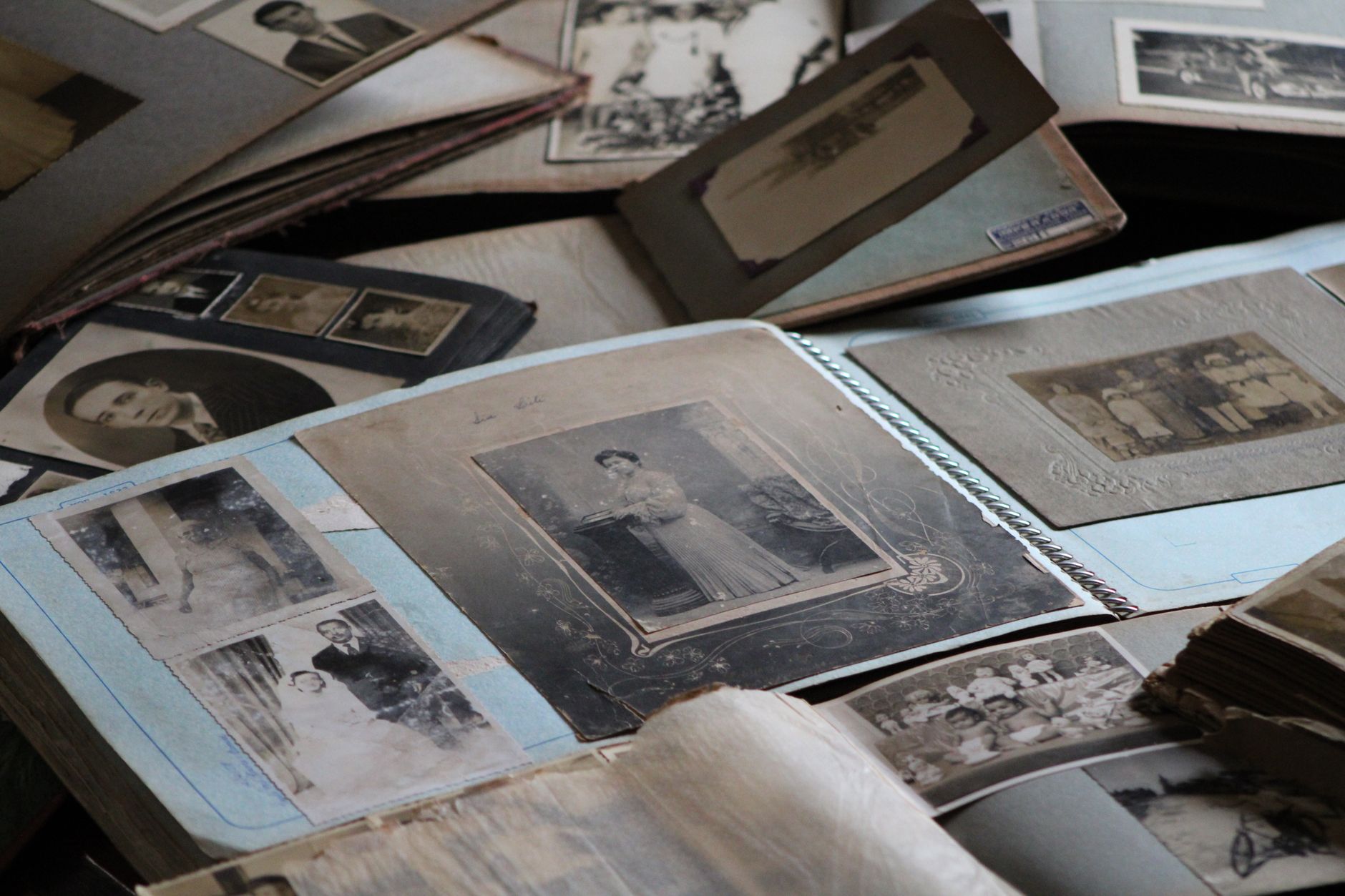
How to Make a Family Memory Book (That Someone Will Actually Open)
What is a family memory book? It's a collection of photos, stories, and details about your family, kept in one place and organised so someone else can understand it. A good one isn't a scrapbook of pretty pages — it's a book where every photo has names, every story has a date, and a reader who never met these people can still follow who's who.
---
My aunt made a family memory book in 2004.
Leather cover. Gold lettering. Two hundred pages.
It took her three years.
I have opened it twice.
Both times I closed it after four pages.
Not because it was bad.
Because it was one hundred and eighty photographs of people I could not identify, arranged beautifully, with captions like "Summer, the old days" and "Happy times together."
Last year my cousin made a different one.
Thirty pages. Printed at a copy shop. No leather.
Every photo has a name under it. Some have four sentences. One has a full page about why our grandmother never sat with her back to a door.
I have read it six times.
I have read parts of it out loud to my children.
Two hundred pages that nobody opens is not a memory book.
It's a beautiful object about strangers.
---
The one rule
Every photo needs a name.
That's it. That's the rule that separates a book people read from a book people inherit and quietly put in a cupboard.
A photo without a name is decoration. A photo with a name is a person.
---
Step 1: Choose thirty photos, not three hundred
The instinct is completeness. Completeness is why it never gets finished.
Thirty photos is a book you'll actually finish this year. Three hundred is a project you'll abandon in March.
Pick thirty. You can make a second book later — and you will, because the first one worked.
Step 2: Caption in four parts
For each photo: - Who (full names, not "Mum") - When (a year is enough; "around 1978" is fine) - Where - What was happening
"Grandma and Uncle in the yard" tells the next generation nothing.
"Chen Meiling and her brother, in the yard behind the Nanjing house, around 1978. This was the summer he came back." That's a person, a place, and a door into a story.
Step 3: Give five photos a full page
Most photos get a caption. Five get a story.
Choose the five people always ask about, and write four to six sentences each. This is where a memory book becomes something read instead of flipped.
Step 4: Include the unglamorous
Weddings and graduations are already documented.
What isn't: the kitchen, the car, the street, the ugly sofa everyone remembers, what the house looked like before it was renovated.
These are the pages grandchildren stare at longest.
Step 5: Write down what you don't know
"I don't know who the man on the left is. He appears in three photos from these years and nobody left can identify him."
Do not delete the gaps. Label them. A named gap is a research lead. An unnamed one is a dead end.
Step 6: Decide how it survives
A printed book can be held, and burns, floods, and fades. A digital archive can be copied and searched, and disappears when a login is forgotten.
Do both. Print the thirty pages. Keep the full version — every photo, every recording, every story — somewhere your family can reach without needing your password.
---
Printed book or digital archive?
Printed is better for reading together. Digital is better for keeping, adding to, and sharing with relatives who live somewhere else.
Most families need a small printed book and a complete digital archive behind it.
The book is what gets opened. The archive is what survives.
---
One more thing, from Homeriah
The best family memory book is not the most beautiful one.
It's the one where a ten-year-old can point at a face and be told a name.
---
Memory Prompt
Choose one photo tonight. Write the four parts underneath it: who, when, where, what was happening. Use full names. That's page one.
That's one page done. Try one more tomorrow.
8/4/2026